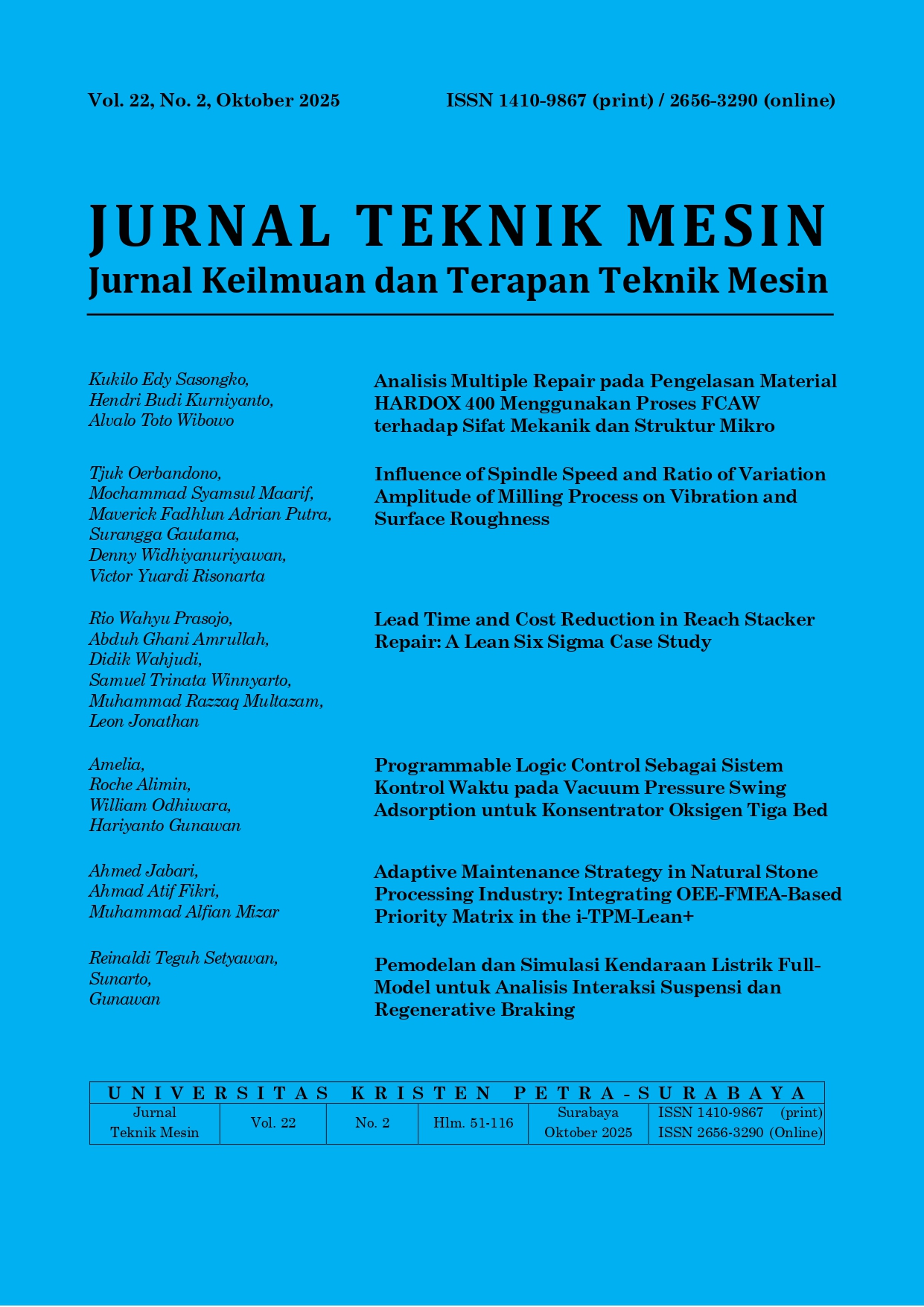
Influence of Spindle Speed and Ratio of Variation Amplitude of Milling Process on Vibration and Surface Roughness
DOI:
https://doi.org/10.9744/jtm.22.2.67-76Keywords:
CNC machine, spindle speed variation, ratio of variation amplitude, , vibration, surface roughnessAbstract
Manufacture technology by using a computer numerical control (CNC) based machine has developed rapidly, particularly in the milling process. This technology, however, still experiences challenges, one of which is chatter. To prevent chatter, several methods are used, i.e. passive, active and spindle speed variation (SSV) methods. The SSV method is easy to apply since it does not require additional tools and only uses a certain algorithm to control the spindle speed. Aluminum alloys are selected as materials for various components since it is easy to machine, corrosion resistant, lightweight, and has a high strength to weight ratio. However, series 5xxx aluminum alloys have relatively low machinability. This experimental method research using a slot milling machine aims to validate the SSV system applied to the Router 2600 Pro to Aluminum 5052 and to determine the effect of SSV modulation amplitude on the surface roughness of 5052 aluminum with RVA variations of 0 (or without SSV) to 30%. In addition, the spindle speed was also varied at 3,000; 5,000 and 9,000 rotations per minute. During the machining process, an accelerometer sensor was installed to record vibration data. The results of surface roughness measurement and vibration analysis show that the best RVA was at 20%. If the RVA increased to 30%, the vibration increased and the surface roughness worsened. Meanwhile, the best nominal spindle speeds that produce low surface roughness are 5,000 and 9,000 RPM.
References
Fortune business inside, CNC (Computer Numerical Control) machine market size, share & industry analysis, https://www.fortunebusinessinsights.com/industry-reports/computer-numerical-controls-cnc-machine-tools-market-101707, retrieved in May 2025
C. Kulkarni and G. Bagale “Defect identification in CNC manufactured products and their control measure”, International Journal of Innovative Research in Science, Engineering and Technology, vol. 6, no. 7, 2017, doi:10.15680/IJIRSET.2017.0607169
A. Basit, N.B. Khan, S. Ali, and R. Muhammad, “Chatter detection and suppression in machining processes: A comprehensive analysis”, International Journal on Interactive Design and Manufacturing, vol. 18, no. 6, pp. 1-21, 2024, doi:10.1007/s12008-023-01716-8
Y. Altintas and M. Weck, “Chatter stability of metal cutting and grinding”, CIRP Annals Manufacture Technology, vol. 53, no. 2, pp. 619–642, 2004, doi: 10.1016/S0007-8506(07)60032-8
G. Quintana and J. Ciurana, “Chatter in machining processes: A review”, International Journal of Machine Tools and Manufacture, vol. 51, no. 5, pp. 363–376, 2011, doi: 10.1016/j.ijmachtools.2011.01.001
B. Liu, C. Liu, X. Yu, Y. Zhou, and D. Wang, “Prediction, detection, and suppression of regenerative chatter in milling”, Advances in Mechanical Engineering, vol. 14, no. 10, pp. 1-26, 2022, doi: 10.1177/168781322211297
D. Longyang, Y. Sun, and Z. Xiong, “Online chatter suppression in turning by adaptive amplitude modulation of spindle speed variation,” Journal of Manufacturing Science and Engineering, vol. 140, no. 2, pp. 1-11, 2018, doi: 10.1115/1.4041248
C. Wang, X. Zhang, Y. Liu, H. Cao, H., and X. Chen, “Stiffness variation method for milling chatter suppression via piezoelectric stack actuators”, International Journal of Machine Tools and Manufacture, vol. 124, no. 1, pp. 53–66, 2018, doi: 10.1016/j.ijmachtools.2017.10.002
P. Albertelli, S. Musletti, M. Leonesio, G. Bianchi, and M. Monno, “Spindle speed variation in turning: Technological effectiveness and applicability to real industrial cases”, The International Journal of Advanced Manufacturing Technology, vol. 62, pp. 59–67, 2012, doi: 10.1007/s00170-011-3790-8
S. Seguy, T. Insperger, L. Arnaud, G. Dessein, and G. Peigné, “On the stability of high-speed milling with spindle speed variation”, The International Journal of Advanced Manufacturing Technology, vol. 48, pp. 883–895, 2010, doi:10.1007/s00170-009-2336-9
M. Zatarin, I. Bediaga, J. Munoa, and R. Lizarralde, “Stability of milling processes with continuous spindle speed variation: Analysis in the frequency and time domains, and experimental correlation”, CIRP Ann, vol. 57, no. 1, pp. 379–384, 2008, doi: 10.1016/j.cirp.2008.03.067
M. Leonesio, “Spindle speed variation in turning: technological effectiveness and applicability to real industrial cases”, The International Journal of Advanced Manufacturing Technology, vol. 62, no. 1, pp. 59–67, 2012, doi: 10.1007/S00170-011-3790-8
X. Dong and W. Zhang, “Stability analysis in milling of the thin walled part considering multiple variables of manufacturing systems”, The International Journal of Advanced Manufacturing Technology, vol. 89, no. 1-4, pp. 515–527, 2017, doi: 10.1007/s00170-016-9072-8
X. Dong, W. Zhang, and S. Deng, “The reconstruction of a [1semi-discretization method for milling stability prediction based on Shannon standard orthogonal basis,” The International Journal of Advanced Manufacturing Technology, vol. 85, no. 5-8, pp. 1501–1511, 2016, doi: 10.1007/s00170-015-7719-5
L. Shujie and Z. Yang, "Stability of milling process with variable spindle speed using Runge–Kutta-based complete method", Mathematical Problems in Engineering, pp. 1-10, 2021, doi: 10.1155/2021/6672513
Y. Ding, X. J. Zhang, and H. Ding, “A Legendre polynomials based method for stability analysis of milling processes”, Journal of Vibration and Acoustics, vol. 137, no. 2, pp. 1-7, 2015, doi: 10.1115/1.4029460
C. Qin, J. Tao, and C. Liu, “Stability analysis for milling operations using an Adams-Simpson-based method”, The International Journal of Advanced Manufacturing Technology, vol. 92, no. 1–4, pp. 969–979, 2017, doi: 10.1007/s00170-017-0186-4
V.Y. Risonarta, J. Anggono, and G.R. Aditya, “The influence of iron concentration on the mechanical properties of A356 Al alloy for car rims application”, Rekayasa Mesin, vol. 11, no. 1, pp. 61-68, 2020, doi: 10.21776/ub.jrm.2020.011.01.7
P.A. Soetjipto, J. Anggono, and V.Y. Risonarta, “Studi pengaruh cat serta pemisahan tutup dan badan kaleng minuman dalam proses peleburan pada kadar Aluminum”, Bachelor thesis, Petra Christian University, Surabaya, Indonesia, 2017
W. Suprapto, V.Y. Risonarta, and A.S. Widodo, “Investigation of microstructure and corrosion resistance of Silumin after Nickel and Copper addition”, EUREKA: Physics & Engineering, vol. 21, no. 3, pp. 137-147, 2024, doi: 10.21303/2461-4262.2024.003086
A. V. Jebaraj, K.V.V. Aditya, T. S. Kumar, L. Ajaykumar, and C.R. Deepak, “Mechanical and corrosion behaviour of aluminum alloy 5083 and its weldment for marine applications”, Materials Today: Proceeding, vol. 22, no. 4, pp. 1470-1478, 2020, doi: 10.1016/j.matpr.2020.01.505
C. R. Song, B. X. Dong, S. Y., Zhang, et al., “Recent progress of Al–Mg alloys: Forming and preparation process, microstructure manipulation and application”, Journal of Materials Research and Technology, vol. 31, no. July–August, pp. 3255-3286, 2024, doi: 10.1016/j.jmrt.2024.07.051
Premiumalu, 5082 Aluminum Alloy, https://premiumalu.com/product/5082-aluminum-alloy/, retrieved in May 2025
H. Caliskan, “Real-time milling chatter detection and control with axis encoder feedback and spindle speed manipulation”, Journal of Manufacture and Materials Processing, vol. 8, no. 4, pp. 1-21, 2024, https://doi.org/10.3390/jmmp8040173
S. Seguy, G. Dessein, L. Arnaud, and T. Insperger, “Control of chatter by spindle speed variation in high-speed milling”, Advanced Materials Research, vol. 112, no. 5, pp. 179-186, 2010, doi: 10.4028/www.scientific.net/AMR.112.179
L. Ding, Y. Sun, and Z. Xiong, “Online chatter suppression in turning by adaptive amplitude modulation of spindle speed variation”, Journal of Manufacturing Science and Engineering, vol. 140, no. 12, pp. 1-14, 2018, doi: 10.1115/1.4041248
P. Albertellia, V. Mussib, C. Ravasioc, and M. Monnoa, “An experimental investigation of the effects of spindle speed variation on tool wear in turning”, Procedia CIRP, vol. 4, pp. 29-34, 2012, doi: 10.1016/j.procir.2012.0.006
V. Y. Risonarta and A.K. Wardhani, “Increasing profitability of a manufacturing company by using the total productive maintenance approach: A review”, International Journal of Mechanical Engineering and Application, vol. 4, no.1, pp. 39-50, 2023, doi: 10.21776/MECHTA.2023.004.01.5
Downloads
Published
Issue
Section
License
Copyright (c) 2025 Tjuk Oerbandono, Mochammad Syamsul Maarif, Maverick Fadhlun Adrian Putra, Surangga Gautama, Denny Widhiyanuriyawan, Victor Yuardi Risonarta

This work is licensed under a Creative Commons Attribution 4.0 International License.
Jurnal Teknik Mesin is publihed by the Mechanical Engineering Department, Petra Christian University, Indonesia

All articles and their contents are published and distributed under the international license of Creative Commons Attribution License (CC BY).