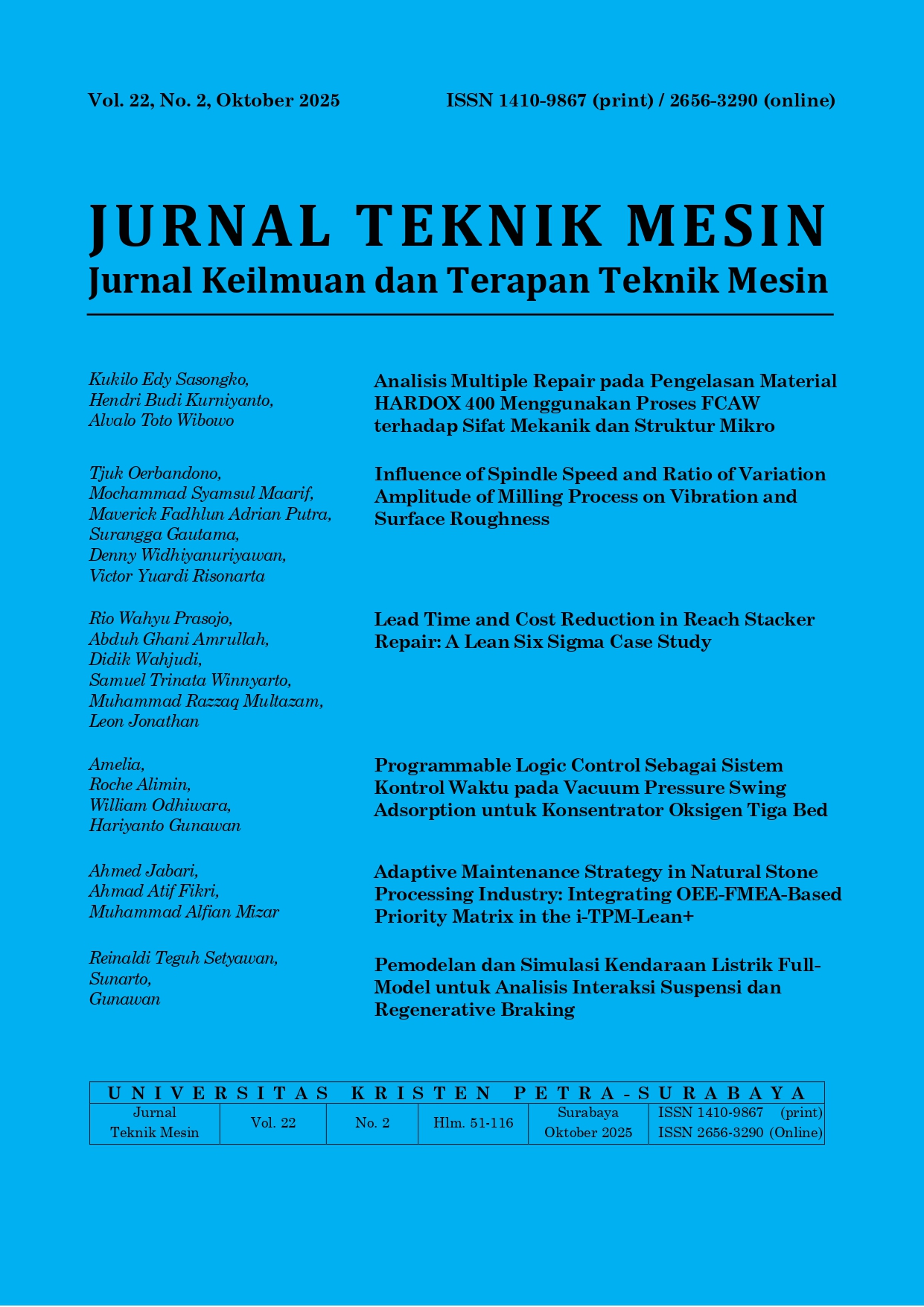
Lead Time and Cost Reduction in Reach Stacker Repair: A Lean Six Sigma Case Study
DOI:
https://doi.org/10.9744/jtm.22.2.77-84Keywords:
Lean Six Sigma, DMAIC, reach stacker, control system, operational efficiency, repair timesAbstract
This study examines the application of the Lean Six Sigma DMAIC methodology to reduce repair times and operational costs in the maintenance of reach stackers at P. T. X, a container shipping company in Indonesia. It identifies the prolonged repair process, often extending to 14 days, primarily due to dependency on original equipment manufacturer suppliers and aging systems, as significant obstacles. The research emphasizes the development of an internally fabricated control system to mitigate these challenges, leading to enhanced operational independence and efficiency. The implementation of DMAIC methodology reduced repair lead time from 14 days to 3 days, achieving a cost reduction of over 90% related to previous downtime expenses caused by Kalmar control system failures. Through detailed analysis, the study highlighted factors contributing to inefficiencies, such as non-interchangeable components linked to identical stock keeping unit numbers, which exacerbated delays. The improved process involved creating tailored control systems, stockpiling essential components, and establishing standard operating procedure for maintenance. Furthermore, training programs for the maintenance team ensured competency in managing the new systems. The results indicate that integrating Lean Six Sigma methodologies with innovation in system development can greatly enhance reliability and efficiency in logistics operations. While this research primarily focused on Kalmar DRD and DRF types, it suggests potential for extending the approach to other reach stacker types. Future studies could investigate the integration of predictive maintenance technologies to improve reliability and reduce downtime in varied operational settings.
References
E. Smirnova, N. Hajiyev, I. Glazkova, and A. Hajiyeva, "Production companies: Evaluation of accessibility and efficiency of transportation and manufacturing processes," The Asian Journal of Shipping and Logistics, vol. 40, no. 1, pp. 52-60, 2024, doi: 10.1016/j.ajsl.2024.01.002.
W. P. Wong, M. F. Anwar, and K. L. Soh, "Transportation 4.0 in supply chain management: State-of-the-art and future directions towards 5.0 in the transportation sector," Operations Management Research, vol. 17, no. 2, pp. 683-710, 2024, doi: 10.1007/s12063-024-00471-7.
A.E. Bempong, "The role of transportation in logistics chain," Texila International Journal of Management, vol. 5, no. 1, pp. 1-4, 2019.
M.R. Islam, M.E.I. Monjur, and T. Akon, "Supply chain management and logistics: How important interconnection is for business success," Open Journal of Business and Management, vol. 11, no. 05, pp. 2505-2524, 2023, doi: 10.4236/ojbm.2023.115139.
F. Wurjaningrum and R.D. Nurrahmani, "Optimizing container delivery services at nilam container terminal: A Lean services approach utilizing VALSAT framework," Southeast Asian Business Review, vol. 3, no. 1, pp. 1-11, 2025, doi: 10.20473/sabr.v3i1.69732.
V.P. Quoc and T.L. Quoc, "Operational efficiency for container terminal operators with undesirable outputs: slacks-based measures," Transportation Planning and Technology, vol. 47, no. 2, pp. 284-301, 2023, doi: 10.1080/03081060.2023.2264277.
C. Danladi, S. Tuck, P. Tziogkidis, L. Tang, and C. Okorie, "Efficiency analysis and benchmarking of container ports operating in lower-middle-income countries: a DEA approach," Journal of Shipping and Trade, vol. 9, no. 1, 2024, doi: 10.1186/s41072-024-00163-2.
D. Steenken, S. Voß, and R. Stahlbock, "Container terminal operation and operations research - a classification and literature review," OR Spectrum, vol. 26, no. 1, pp. 3-49, 2004, doi: 10.1007/s00291-003-0157-z.
T. Tchotang, L. Meva’a, B. Kenmeugne, and P.V. Jatta, "Reliability analysis of a reach stacker in relation to repair maintenance cost and time: a case study of the Gambia sea port," Life Cycle Reliability and Safety Engineering, vol. 9, no. 3, pp. 283-289, 2019, doi: 10.1007/s41872-019-00102-2.
M. Al Bashar, M. A. Taher, and D. Ashrafi, "Enhancing efficiency of material handling equipment in industrial engineering sectors," Iconic Research and Engineering Journals, vol. 7, no. 11, pp. 595-604, 2004.
A. Boujarif, D. W. Coit, O. Jouini, Z. Zeng, and R. Heidsieck, "Repairing smarter: Opportunistic maintenance for a closed-loop supply chain with spare parts dependency," Reliability Engineering & System Safety, vol. 255, 2025, doi: 10.1016/j.ress.2024.110642.
A.O. Betty, O.D. Olanrewaju, O.O. Gbenga, and S.O. Timothy, "Risk management in global supply chains: Addressing vulnerabilities in shipping and logistics," International Journal of Management & Entrepreneurship Research, vol. 6, no. 3, pp. 910-922, 2024, doi: 10.51594/ijmer.v6i3.962.
I. Y. Raharjo and I. N. Sutapa, "Meminimalisasi Frekuensi Downtime pada Mesin Ayakan Pellet 7 di PT Charoen Pokphand Indonesia Feedmill Balaraja," Jurnal Titra, vol. 6, no. 2, pp. 107-114, 2018.
A. Santoso and P. Adi, "Analisis penurunan tingkat kecacatan dengan menggunakan metode DMAIC Di PT. X," Jurnal Teknik Industri, vol. 11, no. 2, pp. 321-328, 2023.
M. F. Rahmadsyah and M. T. Safirin, "Analisis perbaikan downtime mesin injection molding dengan pendekatan DMAIC di PT XYZ," Jupiter: Publikasi Ilmu Keteknikan Industri, Teknik Elektro dan Informatika, vol. 2, no. 1, pp. 25-34, 2024.
Ponidi and A. Makhfud, "Predictive maintenance implementation in reach stacker Kalmar Type Drd To reduce component failure," Rekayasa Energi Manufaktur, vol. 3, no. 1, 2018, doi: 10.21070/r.e.m.v3i1.1538.
K. Antosz, M. Jasiulewicz-Kaczmarek, R. Waszkowski, and J. Machado, "Application of Lean Six Sigma for sustainable maintenance: case study," IFAC PapersOnLine, vol. 55, no. 19, pp. 181-186, 2022, doi: 10.1016/j.ifacol.2022.09.204.
J. Antony, R. Snee, and R. Hoerl, "Lean Six Sigma: yesterday, today and tomorrow," International Journal of Quality & Reliability Management, vol. 34, no. 7, pp. 1073-1093, 2017, doi: 10.1108/ijqrm-03-2016-0035.
I. T. B. Widiwati, S. D. Liman, and F. Nurprihatin, "The implementation of Lean Six Sigma approach to minimize waste at a food manufacturing industry," Journal of Engineering Research, 2024, doi: 10.1016/j.jer.2024.01.022.
W. S. Wahyudhi and A. Subroto, "The Use of Lean Six Sigma to improve key performance indicators on the plant division of PT. PPN," Advances in Economics, Business and Management Research, vol. 36, pp. 688-698, 2017.
M. H. A. Soliman, "A Comprehensive review of manufacturing wastes: Toyota production system lean principles," Emirates Journal for Engineering Research, vol. 22, no. 2, pp. 1-10, 2017, doi: 10.6084/M9.FIGSHARE.9121283.
E. R. G. Pedersen and M. Huniche, "Determinants of lean success and failure in the Danish public sector," International Journal of Public Sector Management, vol. 24, no. 5, pp. 403-420, 2011, doi: 10.1108/09513551111147141.
G. Ringen and H. Holtskog, "How enablers for lean product development motivate engineers," International Journal of Computer Integrated Manufacturing, vol. 26, no. 12, pp. 1117-1127, 2013, doi: 10.1080/0951192x.2011.593046.
Downloads
Published
Issue
Section
License
Copyright (c) 2025 Rio Wahyu Prasojo, Abduh Ghani Amrullah, Didik Wahjudi, Samuel Trinata Winnyarto, Muhammad Razzaq Multazam, Leon Jonathan

This work is licensed under a Creative Commons Attribution 4.0 International License.
Jurnal Teknik Mesin is publihed by the Mechanical Engineering Department, Petra Christian University, Indonesia

All articles and their contents are published and distributed under the international license of Creative Commons Attribution License (CC BY).