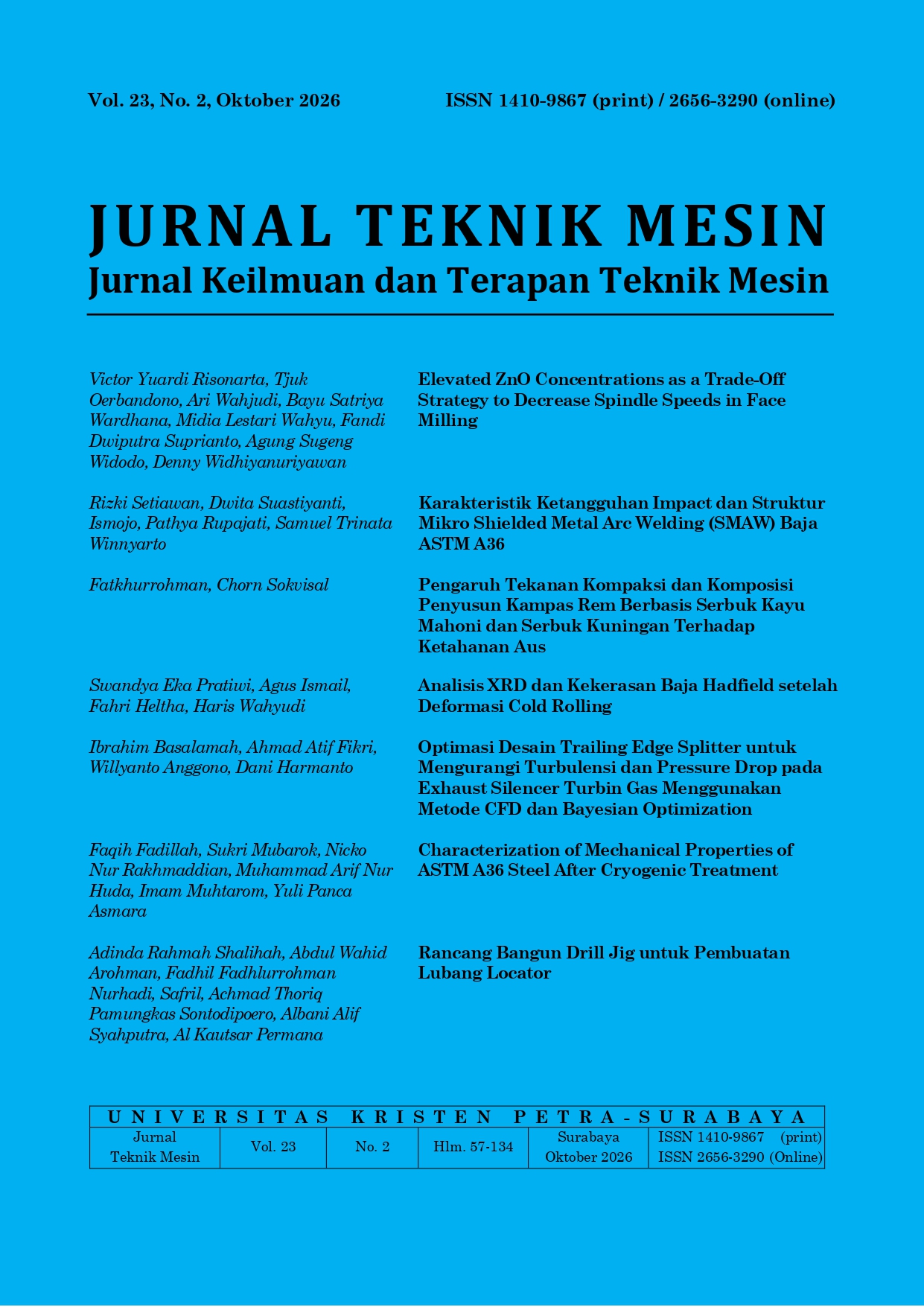
Characterization of Mechanical Properties of ASTM A36 Steel After Cryogenic Treatment
DOI:
https://doi.org/10.9744/jtm.23.2.114-121Keywords:
deep cryogenic treatment, ASTM A36, mechanical propertiesAbstract
The use of ASTM A36 steel through the cold bending process is often faced with material durability due to the occurrence of fine cracks in the process. Fine cracks can increase the risk of corrosion so in the long run it can reduce mechanical strength. The method of repairing steel structures by conventional methods (quenching) has disadvantages such as distortion and cracking in the steel, thereby reducing ductility and other mechanical properties. Deep cryogenic treatment (DCT) emerged as an alternative to overcome the shortcomings of conventional methods in a more effective way so that it can improve the structure of steel without causing distortion and cracking in the steel. This study focused on the analysis of ASTM A36 steels that have been DCT treated, with variations in immersion time (0, 12, 36, 60 hours) followed by characterization of mechanical properties (bending strength, tensile strength, and impact) and physical properties (microstructure). Cryogenic treatment significantly improves the mechanical capabilities of steel through granular refinement and microstructural homogeneity. Mechanical properties indicate that the sample treated for 60 hours shows the smallest grain size with the highest tensile strength (392.4 MPa), and the largest modulus of elasticity (1752.6 MPa). However, the ultimate strain decreased from 19.47% to 36 hours to 18.31% at 60 hours, corresponding to a relative reduction of approximately 5.96%. The best bending strength (892.81 MPa) is achieved after 12 hours. Impact toughness also increased with a longer duration, peaking at 290.08 J for 60 hours. These results emphasize the important role of cryogenic treatment in optimizing ASTM A36 steel for structural applications, where the balance between strength, rigidity, and toughness is critical. However, long soaking durations can lead to diminishing results, such as reduced ductility and bending strength, which require optimization of cryogenic parameters.
References
Industry Research Co, "Worldwide Market Research Report, Analysis & Consulting,", retrieved in April 2026, https://www.industryresearch.co/enquiry/request-sample/26805720?utm_source=PP_23_LNQYR2&trk=article-ssr-frontend-pulse_little-text-block.
A. A. Prakash, A. Shahazad, K. Virendra, G. Pallav, “Investigating the impact of heat treatment on mechanical behaviour of A36 low-carbon steel,’ The Committee of Thermodynamics and Combustion of the Polish Academy of Sciences and The Institute of Fluid-Flow Machinery Polish Academy of Sciences, Vol. 46(2025), No. 3, 141‒149; doi: 10.24425/ather.2025.156586
R. Hindroyuwono, R. A. Marvianto, E. F. Almaida, and Y. B. Arafat, "Static Loading Simulation on Temporary Platform and Ladder Absorbent Chamber Design," International Journal of Engineering Continuity, vol. 3, no. 1, pp. 118–125, 2024, doi: 10.58291/ijec.v3i1.247.
R. A. Braga Jr., R. R. Magalhaes, R. P. Melo, and J. V. Gomes, "Maps of Deformations in a Cantilever Beam Using Particle Image Velocimetry (PIV) and Speckle Patterns," Rem: Escola de Minas Magazine, vol. 68, no. 3, pp. 273–278, 2015, doi: 10.1590/0370-44672013680016.
Z. N. Abdellah, M. Keddam, and P. Jurči, "Simulation of Boronizing Kinetics of ASTM A36 Steel with The Alternative Kinetic Model and The Integral Method," Koroze a Okhrana Materialu, vol. 65, no. 1, pp. 33–39, May 2021, doi: 10.2478/kom-2021-0004.
S. Deb and S. K. Panigrahi, "Bending of Sheet Metals," in Metal Forming Processes, Boca Raton: CRC Press, Boca Raton, USA, 2022, doi: 10.1201/9781003226703-3.
G. Ma, M. Yang, Z. Geng, Y. Ding, H. Liu, and Y. Jin, "Effect of Heat Treatment on Mechanical Properties and Fracture Behavior of Al-7.0Si-0.3Mg Alloy at Low Temperature," Crystals (Basel), vol. 12, no. 4, Article 563, 2022, doi: 10.3390/cryst12040563.
Z. Weng, K. Gu, K. Wang, X. Liu, and J. Wang, "The Reinforcement Role of Deep Cryogenic Treatment on The Strength and Toughness of Alloy Structural Steel," Materials Science and Engineering: A, vol. 772, Article 138698, 2020, doi: 10.1016/j.msea.2019.138698.
H. Zhang, X. Yan, Q. Hou, and Z. Chen, "Effect of Cyclic Cryogenic Treatment on Wear Resistance, Impact Toughness, and Microstructure of 42CrMo Steel and Its Optimization," Advances in Materials Science and Engineering, no. 1, Article 870282, 2021, doi: 10.1155/2021/8870282.
H. Pratikno, A. H. Baredwan, and W. L. Dhanista, "Effect of Preheating Process and V Groove Type on the Tensile and Metallography Test of ASTM A53 with A36 Weld Joint Using FCAW Method," International Journal of Offshore and Coastal Engineering, vol. 6, no. 2, pp. 40–45, 2021, doi: 10.12962/j25800914.v6i2.14769.
X. Wei et al., "Influence of Deep Cryogenic Treatment on Microstructural Evolution and Transformation Kinetics Simulation by Finite Element Method of Low‐Carbon High‐Alloy Martensitic‐Bearing Steel,” Steel Research International, vol. 93, no. 9, Article 2100785, 2022, doi: 10.1002/srin.202100785.
Y. Yan, Z. Luo, K. Liu, C. Zhang, M. Wang, and X. Wang, "Effect of Cryogenic Treatment on the Microstructure and Wear Resistance of 17Cr2Ni2MoVNb Carburizing Gear Steel," Coatings, vol. 12, no. 2, Article 281, 2022, doi: 10.3390/coatings12020281.
Z. Chen, L. Jing, Y. Gao, Y. Huang, J. Guo, and X. Yan, "Impact of Cryogenic Treatment Process on the Performance of 51CrV4 Steel," Materials, vol. 16, no. 12, Article 4399, 2023, doi: 10.3390/ma16124399.
V. Yarasu, P. Jurci, J. Ptacinova, I. Dlouhy, and J. Hornik, "Effect of Cryogenic Treatments on Hardness, Fracture Toughness, and Wear Properties of Vanadis 6 Tool Steel," Materials, vol. 17, no. 7, Article 1688, 2024, doi: 10.3390/ma17071688.
D. Senthilkumar and I. Rajendran, "A Research Review on Deep Cryogenic Treatment of Steels," International Journal of Materials and Structural Integrity, vol. 8, no. 1/2/3, pp. 169–184, 2014, doi: 10.1504/IJMSI.2014.064784.
C. C. Sastry, P. Hariharan, M. Pradeep Kumar, and M. A. Muthu-Manickam, "Experimental Investigation on Boring of HSLA ASTM A36 Steel Under Dry, Wet, and Cryogenic Environments," Materials and Manufacturing Processes, vol. 34, no. 12, pp. 1352–1379, 2019, doi: 10.1080/10426914.2019.1643477.
X. Niu, Z. Chen, L. Jing, Y. Huang, and Y. Liu, "Effect of Cryogenic Treatment on Residual Stress and Microstructure of 6061 Aluminum Alloy and Optimization of Parameters," Materials, vol. 17, no. 19, Article 4873, 2024, doi: 10.3390/ma17194873.
J. Li, H. Zeng, Z. Zeng, Y. Zeng, and T. Xie, "Promising Graphene-Based Nanomaterials and Their Biomedical Applications and Potential Risks: A Comprehensive Review," ACS Biomaterials Science Engineering, vol. 7, no. 12, pp. 5363–5396, 2021, doi: 10.1021/acsbiomaterials.1c00875.
F. Shang, J. Kong, D. Du, Z. Zhang, and Y. Li, "Effect of Cryogenic Treatment on Internal Residual Stresses of Hydrogen-Resistant Steel," Micromachinery (Basel), vol. 12, no. 10, Article 1179, Sep. 2021, doi: 10.3390/mi12101179.
P. Jovičević-Klug, T. Kranjec, M. Jovičević-Klug, T. Kosec, and B. Podgornik, "Influence of the Deep Cryogenic Treatment on AISI 52100 and AISI D3 Steel's Corrosion Resistance," Materials, vol. 14, no. 21, Article 6357, 2021, doi: 10.3390/ma14216357.
K. Amini, A. Akhbarizadeh, and S. Javadpour, "Investigating the Effect of The Deep Cryogenic Heat Treatment on The Corrosion Behavior of the 1.2080 Tool Steel," Metallic Materials, vol. 54, no. 05, pp. 331–338, 2016, doi: 10.4149/km_2016_5_331.
İ. Güneş, A. Çiçek, A. G. Çelik, İ. Güneş, and K. Aslantaş, "Effect of Cryogenic Treatments on The Corrosion Resistance and Electrical Conductivity of DIN 100Cr6 Steel," Journal of Characterization, vol. 2, no. 2, pp. 167–175, 2022, doi: 10.29228/JCHAR.63710.
D. Jandová, P. Šuchmann, and J. Nižňanská, "Microstructure of Tool Steel X37CrMoV5 after Cryogenic Treatment and its Effect on Wear Resistance," Key Engineering Materials, vol. 647, pp. 23–37, 2015, doi: 10.4028/www.scientific.net/KEM.647.23.
E. Demir and I. Toktaş, "Effects of Cryogenic Treatment on Residual Stresses of AISI D2 Tool Steel," Metallic Materials, vol. 56, no. 3, pp. 153–161, 2018, doi: 10.4149/km_2018_3_153.
J. P. Pereira, B. A. Hernandez, G. de M. B. Gonçalves, E. A. C. Sousa, and J. M. Pereira, "Analysis of Distortion, Corrosion and Mechanical Properties of Welded ASTM A36 Steel U-Type Profiles," International Journal of Advanced Engineering Research and Science, vol. 10, no. 9, pp. 1–8, 2023, doi: 10.22161/ijaers.109.1.
F. Jiang, T. Masumura, T. Tsuchiyama, and S. Takaki, "Effect of Substitutional Element Addition on Hall-Petch Relationship in Interstitial Free Ferritic Steels," ISIJ International, vol. 59, no. 10, pp. 1929–1931, Oct. 2019, doi: 10.2355/isijinternational. ISIJINT-2019-100.
S. Dangwal, K. Edalati, R. Z. Valiev, and T. G. Langdon, "Breaks in the Hall–Petch Relationship after Severe Plastic Deformation of Magnesium, Aluminum, Copper, and Iron," Crystals (Basel), vol. 13, no. 3, Article 413, 2023, doi: 10.3390/cryst13030413.
Downloads
Published
Issue
Section
License
Copyright (c) 2026 Faqih Fadillah, Sukri Mubarok, Nicko Nur Rakhmaddian, Muhammad Arif Nur Huda, Imam Muhtarom, Yuli Panca Asmara

This work is licensed under a Creative Commons Attribution 4.0 International License.
Jurnal Teknik Mesin is publihed by the Mechanical Engineering Department, Petra Christian University, Indonesia

All articles and their contents are published and distributed under the international license of Creative Commons Attribution License (CC BY).