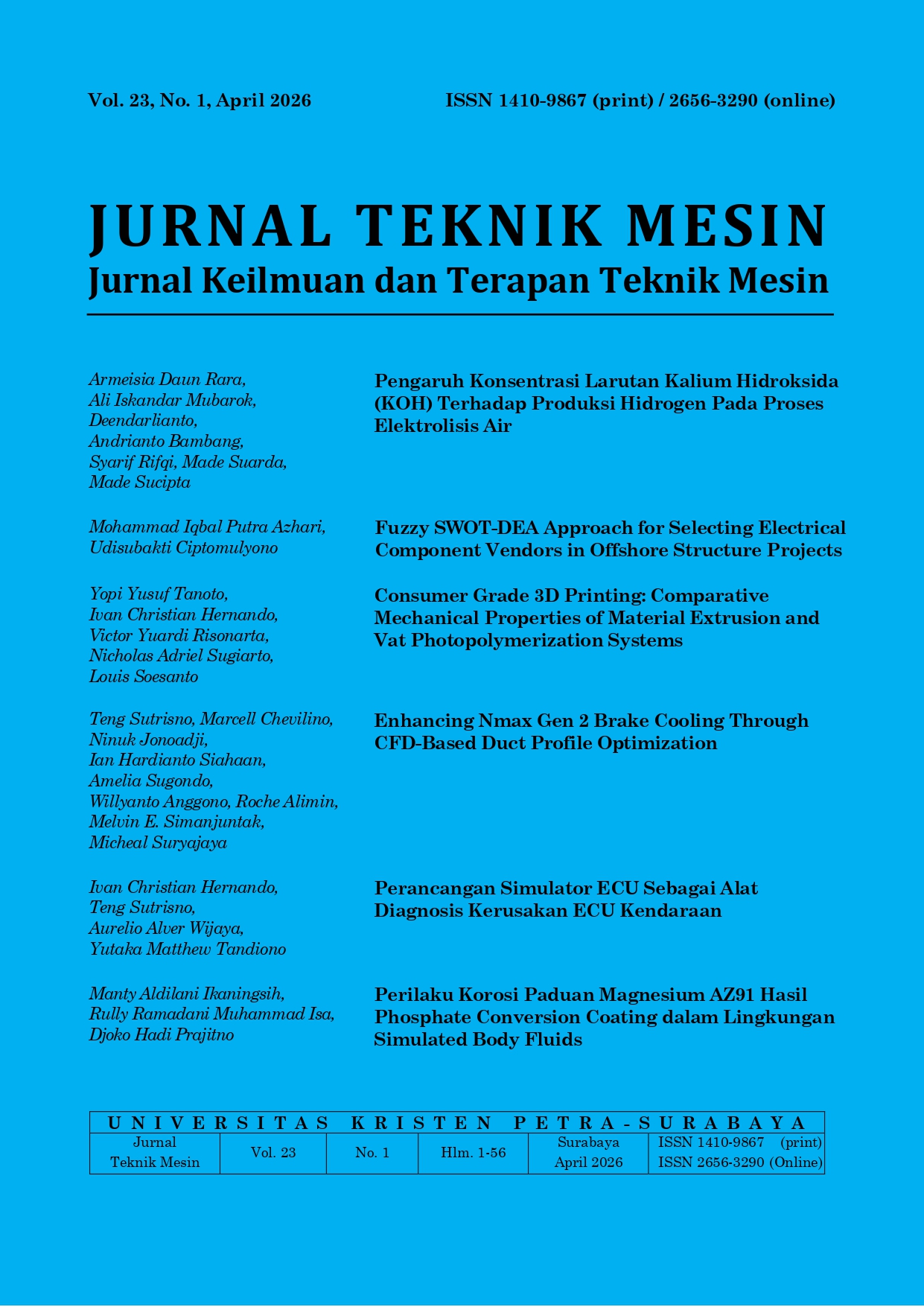
Enhancing Nmax Gen 2 Brake Cooling Through CFD-Based Duct Profile Optimization
DOI:
https://doi.org/10.9744/jtm.23.1.27-34Keywords:
Brake duct, computational fluid dynamics (CFD), cooling system motorcycleAbstract
Efforts to improve the performance of motorcycle brake system performance are essential for enhancing riding safety, particularly at high speeds. The main objective of this study is to evaluate the effect of a brake duct on brake disc cooling using computational fluid dynamics (CFD). This study also aims to determine the optimal brake duct design for motorcycles applications. To assess the accuracy of the numerical simulations, wind tunnel experiments were conducted to quantify the error between the simulation and experimental results. The validation results showed that the simulation error was 5.64%, indicating good agreement with the experimental data. The simulation was performed by modelling the motorcycle braking system and brake duct, then analyzed using ANSYS Fluent. To identify the optimal brake duct configuration, variations in the inner radius R, duct length L, and diffuser size D were evaluated. The best configuration was defined as the design that produced the lowest pressure loss and the highest ΔP statis. The simulation results indicate that the optimal configuration corresponds to R = 20 mm, L = 180 mm, and D = 8.75mmx 10mm.
References
Gilang Satria and Azwar Ferdian, “Beda Kasus Rem Blong Truk di Indonesia dan Jepang, Bagai Bumi dan Langit” Kompas.
C. Bellini, V. Di Cocco, D. Iacoviello, and F. Iacoviello, “Temperature influence on brake pad friction coefficient modelisation,” Materials, vol. 17, no. 1, p. 189, 2023, doi: 10.3390/ma17010189.
M. Hongyu, “Heat dissipation type brake disc that contains rare metal,” CN111207172A, May 29, 2020
R. Jadhav, “Design and optimization of wheels for better aerodynamics and cooling of brakes,” Int J Res Appl Sci Eng Technol, vol. 10, no. 12, pp. 418–440, 2022, doi: 10.22214/ijraset.2022.39853.
P.A. Polyakov, “Study of a segmented ventilation system of the brake disc and determination of the aerodynamic and heat exchange characteristics of the airflow,” iPolytech Journal, vol. 25, no. 6, pp. 720–732, Jan. 2022, doi: 10.21285/1814-3520-2021-6-720-732.
M. Zhang, “Air cooling of disc brake unit by longitudinal vortex generator,” 20200217378, Sep. 07, 2020
M.A. Titus, M.S. Sylvester, and A.A. Cunningham, “Active Brake Cooling Ducts,” US20180313418A1, May 01, 2017 Accessed: Nov. 19, 2025. [Online]. Available: https://patents.google.com/patent/US20180313418A1/en
S. Singh, P. Borthakur, and S. Bahl, “A computational study on structural and thermal behaviour of disc brake rotors with varying design and material,” IOSR Journal of Mechanical and Civil Engineering , vol. 21, no. 2, pp. 1–6, 2024.
S. Zheng, J. Ding, and J. Zuo, “Research on heat dissipation of brake disc in the semi-enclosed space under high-speed train based on fluid-solid-thermal coupling method,” Case Studies in Thermal Engineering, vol. 56, p. 104295, 2024, doi: 10.1016/j.csite.2024.104295.
F.B. Marin and M. Marin, “CFD Modeling of Aerodynamic Car Brake Cooling System,” The Annals of “Dunarea de Jos” University of Galati. Fascicle IX, Metallurgy and Materials Science, vol. 44, no. 4, pp. 44–47, Dec. 2021, doi: 10.35219/mms.2021.4.08.
V. K. Tripathi, R. Saini, and U.K. Joshi, “Design and analysis of ventilated disc brake by using different materials: A review,” Int J Res Appl Sci Eng Technol, vol. 11, no. 8, pp. 627–631, 2023, doi: 10.22214/ijraset.2023.55181.
S. Shofiah, I.N. Syah, S. Hadi, N.O. Widiandaru, and L.O. Asmin, “Statistical analysis of temperature effects on brake force and efficiency in vehicle braking systems: A comprehensive study,” E3S Web of Conferences, vol. 622, p. 01003, 2025, doi: 10.1051/e3sconf/202562201003.
A. Rashid, “Overview of disc brakes and related phenomena - A review,” International Journal of Vehicle Noise and Vibration, vol. 10, no. 4, p. 257, 2014, doi: 10.1504/IJVNV.2014.065634.
C. Li and H.I. Yang, “Optimized shape for improved cooling of ventilated discs,” Alexandria Engineering Journal, vol. 79, pp. 556–567, 2023, doi: 10.1016/j.aej.2023.08.035.
V.K. Agrawal et al., “Optimizing ventilated disk brake design for enhanced thermal performance: an analytical and experimental approach,” Multiscale and Multidisciplinary Modeling, Experiments and Design, vol. 8, no. 4, p. 213, 2025, doi: 10.1007/s41939-025-00797-0.
J. Dewanto, O. Soegihardjo, and A.N.R. Wijaya, “New active cooling system to prevent an overheating on the vehicle disc brake,” International Journal of Industrial Research and Applied Engineering, vol. 3, no. 1, Apr. 2018, doi: 10.9744/jirae.3.1.1-6.
I. Feier, J. Way, and R. Redfield, “Bicycle Disc Brake Thermal Performance: Combining Dynamometer Tests, Bicycle Experiments, and Modeling,” in The 13th Conference of the International Sports Engineering Association, Basel Switzerland: MDPI, Jun. 2020, p. 100. doi: 10.3390/proceedings2020049100.
M.E. Simanjuntak et al., “Kinetic analysis and mathematical modeling of low-rank coal drying by using swirl fluidized bed dryer on varied angles of guide vane and temperatures,” Energy Sources, Part A: Recovery, Utilization, and Environmental Effects, vol. 46, no. 1, pp. 3263–3277, Dec. 2024, doi: 10.1080/15567036.2024.2317435.
M.E. Simanjuntak, M.B.H. Sitorus, U.J. Hutabarat, K.B.A.M. Siahaan, T. Sutrisno, and P.S. Widyawati, “Effect of mass on drying kinetics of andaliman (Zanthoxylum acanthopodium DC.) by swirl fluidized bed drying: A mathematical model,” 2024, p. 040005. doi: 10.1063/5.0183438.
T. Sutrisno et al., “Optimization of the dimple depth and arc length of dimple distance in the intake port for improved engine performance,” AIP Conference Proceedings, p. 040004, 2024, doi: 10.1063/5.0182565.
T. Raja, G. Mathiselvan, M. Sreenivasulureddy, and X. Goldwin Xavier, “Design and analysis of Air flow duct for improving the thermal performance of disc brake rotor,” IOP Conf Ser Mater Sci Eng, vol. 197, p. 012086, May 2017, doi: 10.1088/1757-899X/197/1/012086.
Downloads
Published
Issue
Section
License
Copyright (c) 2026 Teng Sutrisno, Marcell Chevilino, Ninuk Jonoadji, Ian Hardianto Siahaan, Amelia Sugondo, Willyanto Anggono, Roche Alimin, Melvin E. Simanjuntak, Micheal Suryajaya

This work is licensed under a Creative Commons Attribution 4.0 International License.
Jurnal Teknik Mesin is publihed by the Mechanical Engineering Department, Petra Christian University, Indonesia

All articles and their contents are published and distributed under the international license of Creative Commons Attribution License (CC BY).