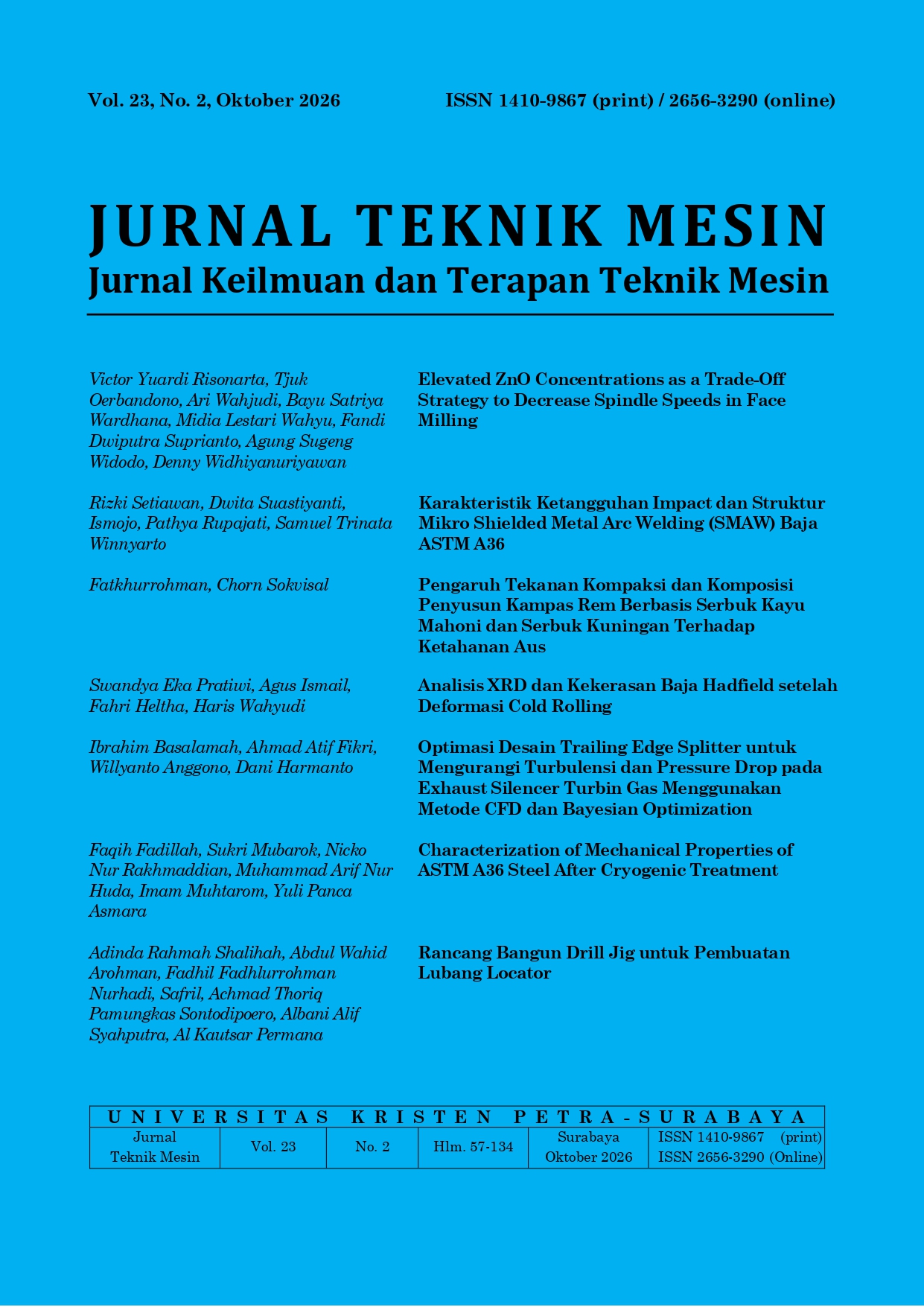
Analisis XRD dan Kekerasan Baja Hadfield setelah Deformasi Cold Rolling
DOI:
https://doi.org/10.9744/jtm.23.2.91-101Keywords:
hadfield, cold rolling, crystallite size, microstrain, Williamson-HallAbstract
Hadfield steel demonstrates outstanding mechanical characteristics, merging significant work-hardening ability with substantial ductility. This research intends to examine the impact of plastic deformation on Hadfield steel via the cold rolling (CR) technique. The examined samples included both as-cast specimens and those subjected to cold reduction (CR) of 20%, 30%, and 40%. The Hadfield steel specimens were fabricated through casting and later sectioned with wire cutting. The samples were subsequently affixed with resin and hardener, then ground and polished before characterization. X-ray diffraction (XRD) was utilized for phase identification, and the diffraction data were examined with HighScore software to ascertain the existing phases, full width at half maximum (FWHM), and approximations of crystallite size and microstrain through Williamson–Hall analysis. Moreover, Vickers hardness assessment utilizing a 30 kgf load was conducted to analyze alterations in hardness due to plastic deformation occurring during cold rolling. The findings indicated that augmenting the extent of plastic deformation via cold rolling led to a reduction in crystallite size, decreasing from 33.68 nm in the as-cast state to 32.91 nm (CR 20%), 22.28 nm (CR 30%), and 21.61 nm (CR 40%). Conversely, the microstrain escalated from 0.53% in the as-cast state to 0.68% (CR 20%), 0.72% (CR 30%), and 0.92% (CR 40%). The rise in microstrain signifies an escalation in lattice distortion as assessed via XRD peak broadening analysis with heightened plastic deformation. The Vickers hardness measurements indicated a rise in hardness corresponding to the level of deformation, progressing from 212.1 ± 10.2 HV30/10 in the as-cast state to 401.4 ± 6.6 HV30/10 (CR 20%), 469.7 ± 18.4 HV30/10 (CR 30%), and 525.7 ± 56.0 HV30/10 (CR 40%). The noted enhancement in hardness aligns with strain hardening caused by plastic deformation throughout the cold rolling procedure.
References
F. C. Liu, Z. N. Yang, C. L. Zheng, and F. C. Zhang, “Simultaneously Improving The Strength and Ductility of Coarse-Grained Hadfield Steel with Increasing Strain Rate,” Scripta Materialia, vol. 66, no. 7, pp. 431–434, 2012, doi: 10.1016/j.scriptamat.2011.12.005.
H. Enginsoy, E. Bayraktar, and A. Kurşun, “A Comprehensive Study on the Deformation Behavior of Hadfield Steel Sheets Subjected to the Drop Weight Test: Experimental Study and Finite Element Modeling,” Metals (Basel), vol. 8, no. 9, Article 734, 2018, doi: 10.3390/met8090734.
D. Bańkowski, P. S. Młynarczyk, W. Depczyński, and K. C. Bolanowski, “The Effect of Work Hardening on the Structure and Hardness of Hadfield Steel,” Archives of Foundry Engineering, vol. 2024, no. 1, pp.14–20, 2024, doi: 10.24425/afe.2024.149246.
G. Tressia, T. Tepedino, M. Masoumi, and J. I. Pereira, “Microstructural Evolution and Strain-Hardening Behavior in Hadfield Steel Railway Crossings,” Tribology in Industry, vol. 46, no. 4, pp.639–650, 2024, doi: 10.24874/ti.1744.08.24.10.
L. Xiaoyun, W. Wei, Z. Fangqiu, L. Lanjun, and Z. Xianfeng, “Influence of Impact Energy on Work Hardening Ability of Austenitic Manganese Steel and Its Mechanism,” China Foundry, vol. 9, no. 3, pp. 248–251, 2012.
X. Yan, Z. Chai, Z. Zhou, and Z. Hou, “The Coupled Effect of SFE and Microstructural Evolution on Wear Resistance in Hadfield Steel at Different Temperatures,” Wear, vol. 578–579, Article 205833, 2025, doi: 10.1016/j.wear.2025.205833.
Y. H. Wen, H. B. Peng, H. T. Si, R. L. Xiong, and D. Raabe, “A Novel High Manganese Austenitic Steel with Higher Work Hardening Capacity and Much Lower Impact Deformation than Hadfield Manganese Steel,” Materials and Design, vol. 55, pp. 798–804, 2014, doi: 10.1016/j.matdes.2013.09.057.
M. Zemlik, Ł. Konat, K. Leśny, and K. Jamroziak, “Comparison of Abrasive Wear Resistance of Hardox Steel and Hadfield Cast Steel,” Applied Sciences (Switzerland), vol. 14, no. 23, Article 11141, 2024, doi: 10.3390/app142311141.
B. Hutchinson and N. Ridley, “On Dislocation Accumulation and Work Hardening in Hadfield Steel,” Scripta Materialia, vo. 55, no. 4, pp. 299–320, 2006, doi: 10.1016/j.scriptamat.2006.05.002.
F. C. Liu, B. Lv, F. C. Zhang, and S. Yang, “Enhanced Work Hardening in Hadfield Steel During Explosive Treatment,” Materials Letters, vol. 65, no. 15–16, pp. 2333–2336, 2011, doi: 10.1016/j.matlet.2011.05.041.
F. C. Zhang, Z. N. Yang, L. H. Qian, F. C. Liu, B. Lv, and M. Zhang, “High Speed Pounding: A Novel Technique for The Preparation of A Thick Surface Layer with A Hardness Gradient Distribution on Hadfield Steel,” Scripta Materialia, vol. 64, no. 6, pp. 560–563, 2011, doi: 10.1016/j.scriptamat.2010.11.043.
J. A. Castañeda, O. A. Zambrano, G. A. Alcázar, S. A. Rodríguez, and J. J. Coronado, “Stacking Fault Energy Determination in Fe-Mn-Al-C Austenitic Steels by X-Ray Diffraction,” Metals (Basel), vol. 11, no. 11, Article 1701, 2021, doi: 10.3390/met11111701.
Y. Kong et al., “Influence of Stacking Fault Energy and Hydrogen on Deformation Mechanisms in High Mn Austenitic Steels during In-Situ Tensile Testing,” International Journal of Hydrogen Energy, vol. 148, Article 149833, 2025, doi: 10.1016/j.ijhydene.2025.06.023.
H. Wahyudi, S. E. Pratiwi, S. Alva, and S. Subekti, “Menentukan Nilai Energi Stacking Fault Paduan Baja Mangan Fe-Mn-C-Cr Menggunakan Persamaan Termodinamika,” Rotasi, vol. 27, no. 2, pp. 77–83, 2025, doi: 10.14710/rotasi.27.2.77-83.
H. S. Lipson, “ X-ray Diffraction by B. E. Warren,” Acta Crystallographica Section A, vol. 27, no. 2, p. 2, 1971, doi: 10.1107/s0567739471000445.
M. A. Ikaningsih, R. R. M. Isa, and D. H. Prajitno, “Perilaku Korosi Paduan Magnesium AZ91 Hasil Phosphate Conversion Coating dalam Lingkungan Simulated Body Fluids,” Jurnal Teknik Mesin, vol. 23, no. 1, pp. 43–56, 2026, doi: 10.9744/jtm.23.1.43-56.
P. Scherrer, “Determination of Size and Inner Structure of Colloidal Particles By X-Ray (Bestimmung der Grösse und der inneren Struktur von Kolloidteilchen mittels Röntgenstrahlen),” Nachrichten von der Gesellschaft der Wissenschaften zu Göttingen, Mathematisch-Physikalische Klasse, vol. 1918, 1918.
A. Monshi, M. R. Foroughi, and M. R. Monshi, “Modified Scherrer Equation to Estimate More Accurately Nano-Crystallite Size Using XRD,” World Journal of Nano Science and Engineering, vol. 2, no. 3, pp. 154–160, 2012, doi: 10.4236/wjnse.2012.23020.
M. T. Ulhakim, S. Sukarman, K. Khoirudin, N. Fazrin, T. Irfani, and A. Hakim, “Determining The Crystallite Size of TiO2/EG-Water XRD Data Using the Scherrer Equation,” Indonesian Journal of Applied Physics, vol. 14, no. 1, pp. 141–150, 2024, doi: 10.13057/ijap.v14i1.79195.
S. A. Disha, M. Sahadat Hossain, M. L. Habib, and S. Ahmed, “Calculation of Crystallite Sizes of Pure and Metals Doped Hydroxyapatite Engaging Scherrer Method, Halder-Wagner Method, Williamson-Hall Model, and Size-Strain Plot,” Results in Materials, vol. 21, Article 100496, 2024, doi: 10.1016/j.rinma.2023.100496.
M. R. Jannat et al., “Validity of Crystallite Size Determination Methods Based on XRD Peak Broadening in Pure and Metal-Doped Nickel Ferrites,” Results in Materials, vol. 28, Article 100762, 2025, doi: 10.1016/j.rinma.2025.100762.
M. K. Alam, M. S. Hossain, N. M. Bahadur, and S. Ahmed, “A Comparative Study in Estimating of Crystallite Sizes of Synthesized and Natural Hydroxyapatites using Scherrer Method, Williamson-Hall model, Size-Strain Plot and Halder-Wagner Method,” Journal of Molecular Structure, vol. 1306, Article 137820, 2024, doi: 10.1016/j.molstruc.2024.137820.
S. I. Yusuf, S. J. Mohammad, and M. H. Ali, “Scherrer and Williamson-Hall Estimated Particle Size Using XRD Analysis for Cast Aluminum Alloys,” Journal of Theoretical and Applied Physics, vol. 18, Article 17, 2024, doi: 10.57647/j.jtap.2024.si-AICIS23.17.
M. Y. A. Mostafa, A. Mostafa, M. Abdel-Rahman, E. E. Assem, A. Ashour, and E. A. Badawi, “XRD Peak Broadening Modelling for Al-Alloys Characterization Compared with Rietveld Profile Analysis,” Materials Today: Proceedings, vol. 120, pp. 89–04, 2023, doi: 10.1016/j.matpr.2023.04.252.
ASTM International, “ASTM 128/128M-19: Standard Specification for Steel Castings, Austenitic Manganese,” 2003, doi: 10.1520/A0128_A0128M-19
J. I. Langford and A. J. C. Wilson, “Scherrer After Sixty Years: A Survey and Some New Results in The Determination of Crystallite Size,” Journal of Applied Crystallography, vol. 11, no. 2, pp. 102–113, 1978, doi: 10.1107/s0021889878012844.
A. Leineweber, “Understanding Anisotropic Microstrain Broadening in Rietveld Refinement,” Zeitschrift fur Kristallographie, vol. 226, no. 12, pp. 905–923, 2011, doi: 10.1524/zkri.2011.1413.
A. Leineweber and E. J. Mittemeijer, “Notes on The Order-of-Reflection Dependence of Microstrain Broadening,” Journal of Applied Crystallography, vol. 43, no. 5, pp. 981–989, 2010, doi: 10.1107/S0021889810030451.
G. K. Williamson and W. H. Hall, “X-Ray Line Broadening from Filed Aluminium and Wolfram,” Acta Metallurgica, vol. 1, no. 1, pp. 23–31, 1953, doi: 10.1016/0001-6160(53)90006-6.
K. Nakagawa et al., “Characterization of Dislocation Rearrangement in FCC Metals during Work Hardening using X-Ray Diffraction Line-Profile Analysis,” Quantum Beam Science, vol. 4, no. 4, Article 36, 2020, doi: 10.3390/qubs4040036.
H. Jagodzinski, H. P. Klug und L. E. Alexander “X‐ray Diffraction Procedures for Polycrystalline and Amorphous Materials”, 2nd Edition. John Wiley & Sons, New York‐Sydney‐Toronto 1974
E. G. Astafurova, M. S. Tukeeva, G. G. Maier, E. V. Melnikov, and H. J. Maier, “Microstructure and Mechanical Response of Single-Crystalline High-Manganese Austenitic Steels Under High-Pressure Torsion: The Effect of Stacking-Fault Energy,” Materials Science and Engineering: A, vol. 604, pp. 166–175, 2014, doi: 10.1016/j.msea.2014.03.029.
A. Russakova, A. Zhilkashinova, D. Alontseva, M. Abilev, A. Khozhanov, and A. Zhilkashinova, “Effect of the Dislocation Substructure Parameters of Hadfield Steel on Its Strain Hardening,” Materials, vol. 16, no. 4, Article 1717, 2023, doi: 10.3390/ma16041717.
C. Chen, B. Lv, X. Feng, F. Zhang, and H. Beladi, “Strain Hardening and Nanocrystallization Behaviors in Hadfield Steel Subjected to Surface Severe Plastic Deformation,” Materials Science and Engineering A, vol. 729, pp.178–184, 2018, doi: 10.1016/j.msea.2018.05.059.
G. Tressia and A. Sinatora, “Effect of The Normal Load on The Sliding Wear Behavior of Hadfield Steels,” Wear, vol. 520–521, Article 204657, 2023, doi: 10.1016/j.wear.2023.204657.
Downloads
Published
Issue
Section
License
Copyright (c) 2026 Swandya Eka Pratiwi, Agus Ismail, Fahri Heltha, Haris Wahyudi

This work is licensed under a Creative Commons Attribution 4.0 International License.
Jurnal Teknik Mesin is publihed by the Mechanical Engineering Department, Petra Christian University, Indonesia

All articles and their contents are published and distributed under the international license of Creative Commons Attribution License (CC BY).