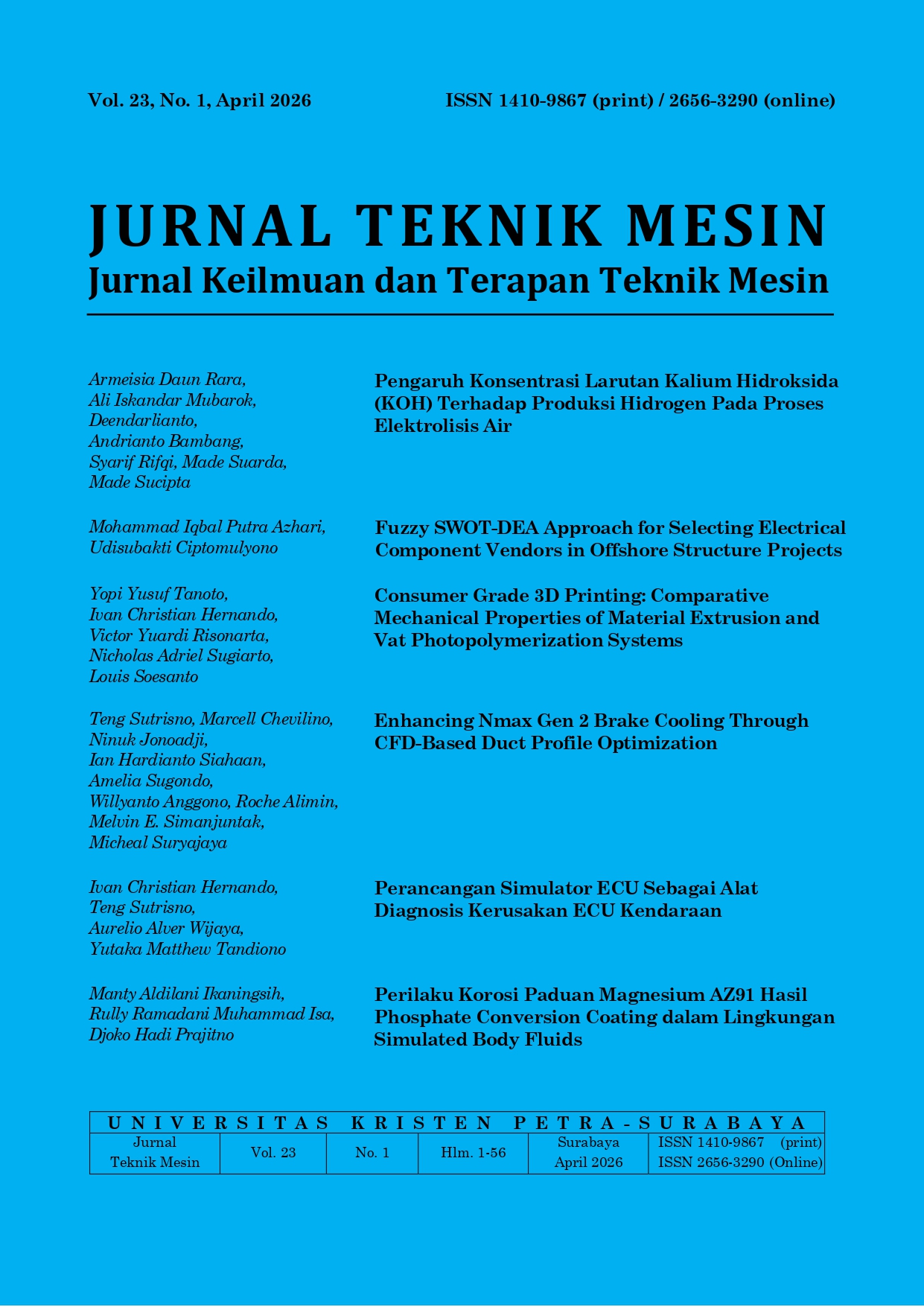
Perilaku Korosi Paduan Magnesium AZ91 Hasil Phosphate Conversion Coating dalam Lingkungan Simulated Body Fluids
DOI:
https://doi.org/10.9744/jtm.23.1.43-56Keywords:
paduan magnesium AZ91, phosphate conversion coating, ketahanan korosi, simulated body fluids, biodegradable biomaterialAbstract
Paduan magnesium AZ91 memiliki potensi sebagai biomaterial biodegradable karena densitas rendah dan sifat mekanik yang baik, namun laju korosi yang tinggi dalam lingkungan fisiologis menjadi kendala utama. Penelitian ini bertujuan untuk mengevaluasi pengaruh phosphate conversion coating (PCC) terhadap perilaku korosi paduan magnesium AZ91 dalam lingkungan simulated body fluids (SBF). Proses PCC dilakukan menggunakan larutan magnesium fosfat dengan pra-aktivasi asam fosfat pada variasi temperatur 40 °C, 60 °C, dan 80 °C serta pH 2,5; 3,0; dan 3,5. Karakterisasi lapisan meliputi pengukuran ketebalan, analisis morfologi dan komposisi unsur (SEM–EDS), pengujian kekerasan Vickers, serta identifikasi fasa kristalin menggunakan X-ray diffraction (XRD), sedangkan ketahan korosi dievaluasi melalui metode potentiodynamic polarization. Hasil penelitian menunjukkan bahwa peningkatan temperatur dan penurunan pH pelapisan menghasilkan lapisan PCC yang lebih tebal, rapat, dan homogen, yang berkontribusi pada peningkatan kekerasan permukaan serta penurunan laju korosi. Kondisi optimum diperoleh pada pH 2,5 dan temperatur 80 °C dengan laju korosi terendah, yang menunjukkan efektivitas lapisan dalam meningkatkan performa perlindungan. Dengan demikian, pengendalian parameter proses PCC menjadi faktor kunci dalam mengoptimalkan ketahanan korosi paduan magnesium AZ91 untuk aplikasi biomaterial biodegradable di lingkungan fisiologis.
References
Y. Xin, K. Huo, T. Hu, G. Tang, and P. K. Chu, “Corrosion products on biomedical magnesium alloy soaked in simulated body fluids,” J. Mater. Res., vol. 24, no. 8, pp. 2711–2719, Aug. 2009, doi: 10.1557/JMR.2009.0323.
R. Zeng, W. Dietzel, F. Witte, N. Hort, and C. Blawert, “Progress and challenge for magnesium alloys as biomaterials,” Adv. Eng. Mater., vol. 10, no. 8, pp. B3–B14, Aug. 2008, doi: 10.1002/ADEM.200800035;JOURNAL:JOURNAL:15272648;WGROUP:STRING:PUBLICATION.
B. Heublein, R. Rohde, V. Kaese, M. Niemeyer, W. Hartung, and A. Haverich, “Biocorrosion of magnesium alloys: a new principle in cardiovascular implant technology?,” Heart, vol. 89, no. 6, pp. 651–656, Jun. 2003, doi: 10.1136/HEART.89.6.651.
G. Song and S. Song, “A possible biodegradable magnesium implant material,” Adv. Eng. Mater., vol. 9, no. 4, pp. 298–302, Apr. 2007, doi: 10.1002/ADEM.200600252;WGROUP:STRING:PUBLICATION.
G. Song and A. Atrens, “Understanding Magnesium Corrosion—A Framework for Improved Alloy Performance,” Adv. Eng. Mater., vol. 5, no. 12, pp. 837–858, Dec. 2003, doi: 10.1002/ADEM.200310405.
S. S. H. V. Voleti, S. Ambuj, T. Sathish, and B. Ratna Sunil, “Comparative Study on the Biodegradation Behavior of Pure Mg in NaCl Solution and Simulated Body Fluids,” Adv. Sci. Technol., vol. 120, pp. 69–73, 2022, doi: 10.4028/P-GRWES4.
Y. Xin, C. Liu, X. Zhang, G. Tang, X. Tian, and P. K. Chu, “Corrosion behavior of biomedical AZ91 magnesium alloy in simulated body fluids,” J. Mater. Res., vol. 22, no. 7, p. 2004, Jul. 2007, doi: 10.1557/jmr.2007.0233.
D. Liu, Y. Li, Y. Zhou, and Y. Ding, “The Preparation, Characterization and Formation Mechanism of a Calcium Phosphate Conversion Coating on Magnesium Alloy AZ91D,” Mater. 2018, Vol. 11, Page 908, vol. 11, no. 6, p. 908, May 2018, doi: 10.3390/MA11060908.
H. Fatima et al., “Hydrothermally Deposited Mg Phosphate Coatings Improve Pure Mg Substrate’s Biocompatibility and Corrosion Resistance for Biomedical Applications,” Asia-Pacific J. Chem. Eng., vol. 20, no. 5, p. e70089, Sep. 2025, doi: 10.1002/APJ.70089;SUBPAGE:STRING:ABSTRACT;WEBSITE:WEBSITE:PERICLES;REQUESTEDJOURNAL:JOURNAL:19322143;ISSUE:ISSUE:DOI.
X. Lu et al., “Formation Mechanism and Corrosion Performance of Phosphate Conversion Coatings on AZ91 and Mg-Gd-Y-Zr Alloy,” J. Electrochem. Soc., vol. 165, no. 10, p. C601, Jul. 2018, doi: 10.1149/2.0221810JES.
C. S. Lin, H. C. Lin, K. M. Lin, and W. C. Lai, “Formation and properties of stannate conversion coatings on AZ61 magnesium alloys,” Corros. Sci., vol. 48, no. 1, p. 93, Jan. 2006, doi: 10.1016/j.corsci.2004.11.023.
T. Wu and K. Zhang, “Corrosion and Protection of Magnesium Alloys: Recent Advances and Future Perspectives,” Coatings, vol. 13, no. 9, 2023, doi: 10.3390/coatings13091533.
Y. Song, D. Shan, R. Chen, F. Zhang, and E. H. Han, “Biodegradable behaviors of AZ31 magnesium alloy in simulated body fluid,” Mater. Sci. Eng., C, vol. 29, no. 3, p. 1039, Apr. 2009, doi: 10.1016/j.msec.2008.08.026.
G. Duan et al., “Designing for the chemical conversion coating with high corrosion resistance and low electrical contact resistance on AZ91D magnesium alloy,” Corros. Sci., vol. 135, p. 197, May 2018, doi: 10.1016/j.corsci.2018.02.051.
L. Yang, N. Hort, R. Willumeit, and F. Feyerabend, “Effects of corrosion environment and proteins on magnesium corrosion,” Corros. Eng. Sci. Technol., vol. 47, no. 5, pp. 335–339, Aug. 2012, doi: 10.1179/1743278212Y.0000000024.
Y. Su, Y. Su, Y. Lu, J. Lian, and G. Li, “Composite Microstructure and Formation Mechanism of Calcium Phosphate Conversion Coating on Magnesium Alloy,” J. Electrochem. Soc., vol. 163, no. 9, p. G138, 2016, doi: 10.1149/2.0801609jes.
F. Soleymani, R. Emadi, and S. Sadeghzade, “Bioactivity Behavior Evaluation of PCL-Chitosan-Nanobaghdadite Coating on AZ91 Magnesium Alloy in Simulated Body Fluid,” Coatings, vol. 10, no. 231, 2020, doi: https://doi.org/10.3390/coatings10030231.
W. Q. Zhou, D. Y. Shan, E.-H. Han, and W. Ke, “Phosphate Conversion Coating on Diecast AZ91D and Its Corrosion Resistance,” Mater. Sci. Forum, vol. 488–489, pp. 819–822, Jul. 2005, doi: 10.4028/WWW.SCIENTIFIC.NET/MSF.488-489.819.
MatWeb, “Magnesium AZ91D-F, Cast.” MatWeb Material Property Data, n.d. https://www.matweb.com/search/datasheet.aspx?MatGUID=07baafbb9c364fb18fd413bceced867f&ckck=1 (accessed Mar. 31, 2026).
ASTM International, “Standard Practice for Calculation of Corrosion Rates and Related Information from Electrochemical Measurements,” vol. 89, no. Reapproved, 1999.
X. Gu, Y. Zheng, Y. Cheng, S. Zhong, and T. Xi, “In vitro corrosion and biocompatibility of binary magnesium alloys,” Biomaterials, vol. 30, no. 4, p. 484, Feb. 2009, doi: 10.1016/j.biomaterials.2008.10.021.
J. E. Gray and B. Luan, “Protective coatings on magnesium and its alloys - A critical review,” J. Alloys Compd., vol. 336, no. 1–2, pp. 88–113, Apr. 2002, doi: 10.1016/S0925-8388(01)01899-0.
M. P. Staiger, A. M. Pietak, J. Huadmai, and G. Dias, “Magnesium and its alloys as orthopedic biomaterials: A review,” Biomaterials, vol. 27, no. 9, p. 1728, Mar. 2006, doi: 10.1016/j.biomaterials.2005.10.003.
W. Zai, Y. Su, H. C. Man, J. Lian, and G. Li, “Effect of pH value and preparation temperature on the formation of magnesium phosphate conversion coatings on AZ31 magnesium alloy,” Appl. Surf. Sci., vol. 492, pp. 314–327, Oct. 2019, doi: 10.1016/J.APSUSC.2019.05.309.
S. Zhang, Y. Xu, L. Liu, Q. Lei, J. Dong, and T. Zhang, “Preparation of Conductive and Corrosion Resistant Phosphate Conversion Coating on AZ91D Magnesium Alloy,” Coatings, vol. 13, no. 10, 2023, doi: 10.3390/coatings13101706.
Downloads
Published
Issue
Section
License
Copyright (c) 2026 Manty Aldilani Ikaningsih, Rully Ramadani Muhammad Isa, Djoko Hadi Prajitno

This work is licensed under a Creative Commons Attribution 4.0 International License.
Jurnal Teknik Mesin is publihed by the Mechanical Engineering Department, Petra Christian University, Indonesia

All articles and their contents are published and distributed under the international license of Creative Commons Attribution License (CC BY).