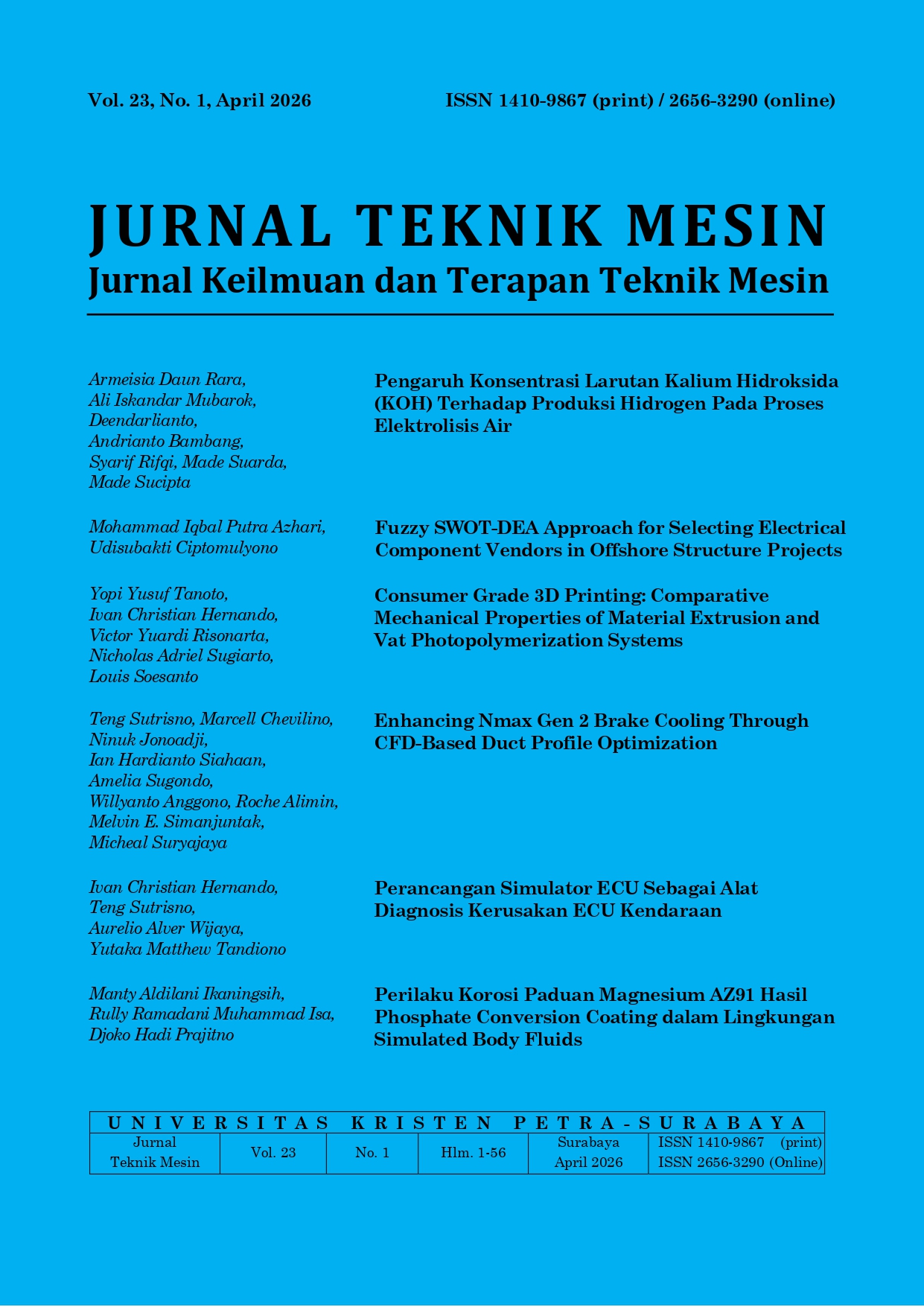
Consumer Grade 3D Printing: Comparative Mechanical Properties of Material Extrusion and Vat Photopolymerization Systems
DOI:
https://doi.org/10.9744/jtm.23.1.21-26Keywords:
consumer-grade 3D printing, FDM, LCD, PLA, mechanical propertiesAbstract
Additive manufacturing (AM) technologies can generally be divided into industrial-grade systems and consumer-grade machines, the latter being more cost-effective and accessible to a broader user base. Within the consumer segment, the most prevalent methods are fused deposition modelling (FDM) and LCD-based vat photopolymerization. Although FDM has been extensively studied, direct performance comparisons between material extrusion (ME) and vat photopolymerization (VP) remain relatively scarce. This study addresses this gap by evaluating the mechanical behavior of both technologies. The results show that LCD-based printing demonstrates superior performance in certain mechanical aspects (elongation), while both entry-level materials achieved comparable tensile strengths of approximately 31.5 MPa. In contrast, the flexural strength was higher in the specimens produced by ME, indicating that each process carries distinct advantages depending on the application.
References
G. Pelin, M. Sonmez, and C.E. Pelin, “The use of additive manufacturing techniques in the development of polymeric molds: A review,” Polymers, vol. 16, p. 1055, 2024, doi: 10.3390/polym16081055.
J. Gardan, “Additive manufacturing technologies: State of the art and trends,” International Journal of Production Research, vol. 54, pp. 3118–3132, 2016, doi: 10.1080/00207543.2015.1115909.
J. Gardan, “Additive manufacturing technologies for polymer composites: State-of-the-art and future trends,” Woodhead Publishing Series in Composites Science and Engineering, pp. 3–15, 2020, doi: 10.1016/B978-0-12-819535-2.00001-6
A. Paolini, S. Kollmannsberger, and E. Rank, “Additive manufacturing in construction: A review on processes, applications, and digital planning methods,” Additive Manufacturing, vol. 30, p. 100894, 2019, doi: 10.1016/j.addma.2019.100894.
M. Pérez, D. Carou, E.M. Rubio, and R. Teti, “Current advances in additive manufacturing,” Procedia CIRP, vol. 88, pp. 439–444, 2020, doi: 10.1016/j.procir.2020.05.076.
Y.Y. Tanoto, J. Anggono, I.H. Siahaan, and W. Budiman, “The effect of orientation difference in fused deposition modeling of ABS polymer on the processing time, dimension accuracy, and strength,” AIP Conference Proceedings, p. 030051, 2017, doi: 10.1063/1.4968304.
K. Wangsawijaya, Y.Y. Tanoto, D. Wahjudi, G.S. San, and J. Herlianto, “A preliminary study of remanufacturing on FDM machine,” AIP Conference Proceedings, p. 020008, 2024, doi: 10.1063/5.0181553.
A. Chalgham, A. Ehrmann, and I. Wickenkamp, “Mechanical properties of FDM printed PLA parts before and after thermal treatment,” Polymers, vol. 13, p. 1239, 2021, doi: 10.3390/polym13081239.
L. Zhou, J. Miller, J. Vezza, M. Mayster, M. Raffay, Q. Justice, et al., “Additive manufacturing: A comprehensive review,” Sensors, vol. 24, p. 2668, 2024, doi: 10.3390/s24092668.
M.S. Andrés, R. Chércoles, E. Navarro, J.M. De La Roja, J. Gorostiza, M. Higueras, et al., “Use of 3D printing PLA and ABS materials for fine art: Analysis of composition and long-term behaviour of raw filament and printed parts,” Journal of Cultural Heritage, vol. 59, pp. 181–189, 2023, doi: 10.1016/j.culher.2022.12.005.
D.A. Rau, M. Kim, B. Xu, and L.H. Cai, “Vat photopolymerization printing of modular soft stretchable low-cost elastomers,” ACS Applied Polymer Materials, vol. 7, pp. 7566–7574, 2025, doi: 10.1021/acsapm.5c01217.
L. Zhou, J. Fu, and Y. He, “A review of 3D printing technologies for soft polymer materials,” Advanced Functional Materials, vol. 30, p. 2000187, 2020, doi: 10.1002/adfm.202000187.
D. Chekkaramkodi, L. Jacob, S.C. Muhammed, R. Umer, and H. Butt, “Review of vat photopolymerization 3D printing of photonic devices,” Additive Manufacturing, vol. 86, p. 104189, 2024, doi: 10.1016/j.addma.2024.104189.
C. Tang, J. Liu, Y. Yang, Y. Liu, S. Jiang, and W. Hao, “Effect of process parameters on mechanical properties of 3D printed PLA lattice structures,” Composites Part C: Open Access, vol. 3, p. 100076, 2020, doi: 10.1016/j.jcomc.2020.100076.
C. Vălean, D.I. Stoia, C. Opriș, and E. Linul, “Effect of fillers on mechanical properties of FDM printed PLA components,” Procedia Structural Integrity, vol. 56, pp. 97–104, 2024, doi: 10.1016/j.prostr.2024.02.043.
Anycubic, “Standard resin V2: Enhanced toughness for impact-resistant 3D prints,” Anycubic Store, 2025. [Online]. Available: https://store.anycubic.com/products/standard-resin-v2. Accessed: Sep. 19, 2025.
eSUN, “PLA+ filament (PLA-Pro),” eSUN, 2025. [Online]. Available: https://www.esun3d.com/pla-pro-product/. Accessed: Sep. 19, 2025.
Phrozen Technology, “Resin vs filament 3D printing: Which one is right for you?”, Phrozen Technology, 2025. [Online]. Available: https://phrozen3d.com/blogs/guides/resin-vs-filament-3d-printing. Accessed: Sep. 19, 2025.
M. Abbasi, P. Váz, J. Silva, and P. Martins, “Head-to-head evaluation of FDM and SLA in additive manufacturing: Performance, cost, and environmental perspectives,” Applied Sciences, vol. 15, p. 2245, 2025, doi: 10.3390/app15042245.
Downloads
Published
Issue
Section
License
Copyright (c) 2026 Yopi Yusuf Tanoto, Ivan Christian Hernando, Victor Yuardi Risonarta, Nicholas Adriel Sugiarto, Louis Soesanto

This work is licensed under a Creative Commons Attribution 4.0 International License.
Jurnal Teknik Mesin is publihed by the Mechanical Engineering Department, Petra Christian University, Indonesia

All articles and their contents are published and distributed under the international license of Creative Commons Attribution License (CC BY).