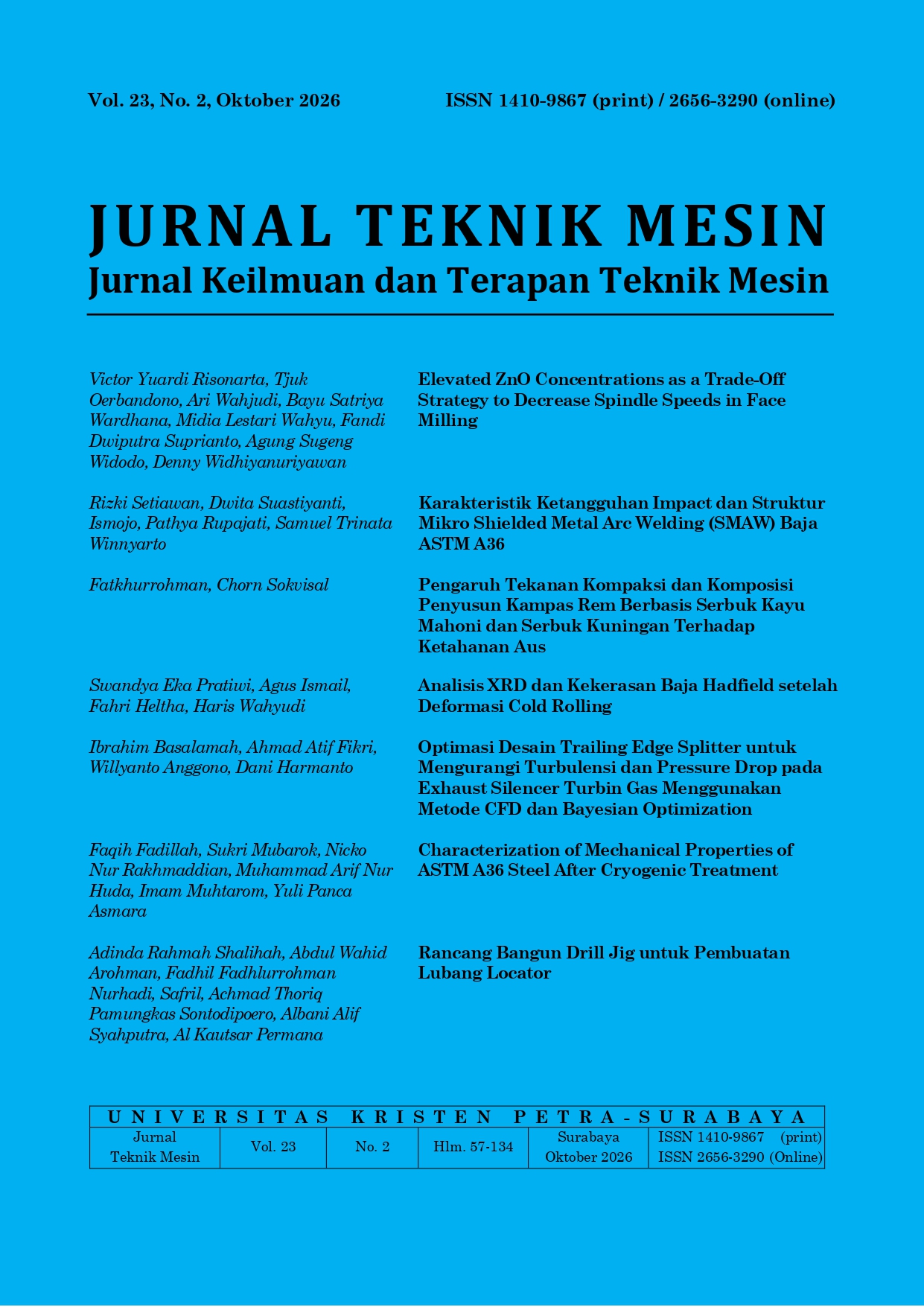
Elevated ZnO Concentrations as a Trade-Off Strategy to Decrease Spindle Speeds in Face Milling
DOI:
https://doi.org/10.9744/jtm.23.2.57-69Keywords:
energy consumption, viscosity, surface-roughness, spindle speed, process optimizationAbstract
Higher productivity, lower cost, environmental requirement and occupational health have become serious challenges for manufacturing industries nowadays. In this study, a mixture comprising canola oil, emulsifier and ZnO nanoparticles was applied as the cutting oil for face milling of stainless steel SS316L. Previous studies have demonstrated decreasing surface roughness with increasing spindle speed. Numerous previous studies have also revealed decreasing surface roughness with increasing ZnO concentrations. However, a relationship between elevated ZnO concentrations and reduced spindle speeds has barely been addressed. Building on this circumstance, a novel machining strategy was proposed in this study by employing elevated ZnO concentrations as a trade-off strategy to reduce the spindle speeds. The spindle speeds in this study were 1500, 1800 and 2100 rpm. The experiment demonstrated that elevating ZnO concentrations from 1.0 to 4.0 wt% could be used to decrease the spindle speeds from 2100 to 1800 rpm while maintaining acceptable surface roughness. Although future studies are warranted, reducing spindle speed is beneficial for manufacturing industries as it may contribute to lower electrical energy consumption. Furthermore, the proposed trade-off strategy can also be implemented for manufacturing industries located in regions with limited electrical grid capacity, for example, due to restricted capacity of electrical transformers.
References
W. Wang, H. Lin, M. Zhou, H. Xie, B. Dai, and S. Han, ”Formulation, characterization, mechanism, and application of vegetable oil-based nano-cutting fluids”, The International Journal of Advanced Manufacturing Technology, vol. 136, pp. 909–923, 2025, https://doi.org/10.1007/s00170-024-14973-y
L. Loss et al., "Environmental aspects of drill cuttings from oil operations: Characterization, risk assessment, valorization, and treatment innovations", International Journal of Environmental Science and Technology, vol. 23, Art. 307, 2026, https://doi.org/10.1007/s13762-026-07078-4
A. Elsheikh et al., "A review on sustainable machining: Technological advancements, health and safety considerations, and related environmental impacts", Results in Engineering, vol. 24, Art. 103042, 2024, https://doi.org/10.1016/j.rineng.2024.103042
M.C. Jacobs and A. Herman, "Contact dermatitis from 2-butyl-1,2-benzisothiazolin-3-one in a cutting fluid", Contact Dermatitis, vol. 83, no. 5, pp. 414–415, 2020, https://doi.org/10.1111/cod.13624
M. Schwarz, M. Dado, R. Hnilica, and D. Veverková, "Environmental and health aspects of metalworking fluid use", Polish Journal of Environmental Studies, vol. 24, no. 1, pp. 37–45, 2015.
R. Zendehdel, E. Asgari-Gandomani, A. Rafieepour, and Z. Panjali, "DNA damage in workers exposed to mineral oils", Drug and Chemical Toxicology, vol. 48, no. 3, pp. 540–546, 2025, https://doi.org/10.1080/01480545.2024.2387803
Y. Raut and A. Bahekar, "Optimization of parameters to reduce the surface roughness in face milling operation on cast iron workpiece by applying Taguchi method", International Journal of Engineering Trends and Technology, vol. 68, no. 1, pp. 9–13, 2020, https://doi.org/10.14445/22315381/IJETT-V68I1P202
B. Stagg and T. Charalampopoulos, "Surface-roughness effects on the determination of optical properties of materials by the reflection method", Applied Optics, vol. 30, no. 28, pp. 4113–4118, 1991, https://doi.org/10.1364/AO.30.004113
C. Beaulieu, D. Vidal, B. Yari, J. Chaouki, and F. Bertrand, "Impact of surface roughness on heat transfer through spherical particle packed beds", Chemical Engineering Science, vol. 231, Art. 116256, 2021, https://doi.org/10.1016/j.ces.2020.116256.
P. Terek et al., "Surface roughness and its effect on adhesion and tribological performance of magnetron sputtered nitride coatings", Coatings, vol. 14, no. 8, Art. 1010, 2024, https://doi.org/10.3390/coatings14081010
J. Chae et al., "Effect of surface roughness and chemical composition of metastable austenitic stainless steels on electrochemical polishing-induced martensitic transformation", Metallurgical and Materials Transactions A, vol. 55, pp. 1207–1216, 2024, https://doi.org/10.1007/s11661-024-07320-z
D.S. Bae and J.K. Lee, "Effect of surface roughness on fatigue strength in martensitic stainless steel", International Journal of Precision Engineering and Manufacturing, vol. 25, pp. 2125–2131, 2024, https://doi.org/10.1007/s12541-024-01079-4
S. Wen, S. Zhou, and X. Liu, "Effect of surface roughness on the determination of the creep properties of material by using three points bending creep test", Advances in Engineering Research, vol. 93, pp. 22–28, 2016, https://doi.org/10.1007/s12541-024-01079-4
F. Wang, Y. Wang, W. Wang, B. Lin, and M. Qu, "Effect of surface roughness on corrosion resistance of mooring chains for offshore floating photovoltaics", Metals, vol. 14, no. 10, Art. 1181, 2024, https://doi.org/10.3390/met14101181
P. Liaparinos and S. David, "The surface-roughness effects on light beam interactions between the CSI phosphor and optical sensing materials", Crystals, vol. 10, Article 174, 2020, https://doi.org/10.3390/cryst10030174
B. Bachchhav and H. Bagchi, "Effect of surface roughness on friction and lubrication regimes", Materials Today, vol. 38, no. 1, pp. 169–173, 2021, https://doi.org/10.1016/j.matpr.2020.06.252
F. Svahn, A. Kassman-Rudolphi, and E. Wallén, "The influence of surface roughness on friction and wear of machine element coatings", Wear, vol. 254, no. 11, pp. 1092–1098, 2003, https://doi.org/10.1016/S0043-1648(03)00341-7
V. Edachery, R. Shashank, and S.V. Kailas, "Influence of surface texture directionality and roughness on wettability, sliding angle, contact angle hysteresis, and lubricant entrapment capability", Tribology International, vol. 158, Article 106932, 2021, https://doi.org/10.1016/j.triboint.2021.106932
M. Donoughue, C. Lumpp, J. Pakulski, and M. McClain, "Material and surface roughness effects on adhesion of thermoplastic-elastomeric interfaces for dissimilar material 3D printing", NPJ Advanced Manufacturing, vol. 2, Article 12, 2025, https://doi.org/10.1038/s44334-025-00023-2
R. Liu, Y. Pan, A. Chen, G. Bin, and H. Li, "Study on the influence of surface roughness on the erosion characteristics of compressor blades", Powder Technology, vol. 430, Article 119037, 2023, https://doi.org/10.1016/j.powtec.2023.119037
C.D. Wen and I. Mudawar, "Modeling the effects of surface roughness on the emissivity of aluminum alloys", International Journal of Heat and Mass Transfer, vol. 49, no. 23–24, pp. 4279–4289, 2006, https://doi.org/10.1016/j.ijheatmasstransfer.2006.04.037
Z. Jiang, G. He, H. Ghassemi, and H. Zhang, "Influence of surface roughness on vibration response characteristics of flexible structures on offshore floating platforms", Sustainable Horizons, vol. 12, Article 100119, 2024, https://doi.org/10.1016/j.horiz.2024.100119
X.L. Liu, Z B. Cai, S.B. Liu, J.F. Peng, and M.H. Zhu, "Effect of roughness on electrical contact performance of electronic components", Microelectronics Reliability, vol. 74, pp. 100–109, 2017, https://doi.org/10.1016/j.microrel.2017.05.024
M. Kadivar, D. Tormey, and G. McGranaghan, "A review on turbulent flow over rough surfaces: Fundamentals and theories", International Journal of Thermofluids, vol. 10, Article 100077, 2021, https://doi.org/10.1016/j.ijft.2021.100077
Y.D. Dwivedi, A. Wahab, A.D. Pallay, and A. Shesham, "Effect of surface roughness on aerodynamic performance of the wing with NACA 4412 airfoil at Reynolds number 1.7 × 10⁵", Materials Today: Proceedings, vol. 56, no. 1, pp. 468–476, 2021, https://doi.org/10.1016/j.matpr.2022.02.153
D. Hue, A. Cartieri, and I. Petropoulos, "Surface roughness effects on transonic aircraft performance: Experimental/numerical comparisons", Aerospace Science and Technology, vol. 154, Article 109507, 2024, https://doi.org/10.1016/j.ast.2024.109507
A. Maneedaeng, A. Wiangkham, A. Ariyarit, A. Pumpuang, and E. Sukjit, "Investigating the impact of fatty acid profiles on biodiesel lubricity using artificial intelligence techniques", Cleaner Engineering and Technology, vol. 25, Article 100913, 2025, https://doi.org/10.1016/j.clet.2025.100913
D. Gasni, H. Putra, and R.M. Nur, "Wear behaviours of sustainable biolubricants: influence of fatty acid compositions and surface roughness in mixed lubrication regimes", Advance Sustainable Science, Engineering and Technology, vol. 7, no. 3, pp. 0250309-01–0250309-08, 2025, https://doi.org/10.26877/asset.v7i3.1761.
S. Tiwari, M. Amarnath, M.K. Gupta, and M.A. Makhesana, "Performance assessment of nano-Al2O3 enriched coconut oil as a cutting fluid in MQL-assisted machining of AISI-1040 steel", The International Journal of Advanced Manufacturing Technology, vol. 129, pp. 1689–1702, 2023, https://doi.org/10.1007/s00170-023-12394-x
S. Tiwari and M. Amarnath, "Improving the machining performance with bio-degradable coconut oil-assisted MQL turning of AISI-1040 steel: A sustainable machining approach", Biomass Conversion and Biorefinery, vol. 14, pp. 24731–24751, 2024, https://doi.org/10.1007/s13399-023-04573-3
I.M. Elewaa, A.M. Galalb, N.S. Sakerc, and A. Abd El Tawab, "Comparative study on the effect of vegetable-based cutting fluid and mineral oil on cutting forces and surface roughness during turning operation", Mansoura Engineering Journal, vol. 40, no. 4, pp. 121–131, 2015, https://doi.org/10.13140/RG.2.2.17476.42889.
S. Gunjal and S. Sana, "Experimental investigation of tool life and chip thickness using vegetable oils as cutting fluids under MQL", Journal of Mines, Metals and Fuels, vol. 72, no. 6, pp. 581–587, 2024, https://doi.org/10.18311/jmmf/2024/4522
X. Xiao, G. Hu, Y. Liang, P. Yan, and A. Jiang, "A review on the properties of zinc oxide nanoparticles in various industries and biomedical fields: Enhancing chemical and physical characteristics", Iranian Journal of Chemistry and Chemical Engineering, vol. 43, no. 1, pp. 46–65, 2024, https://doi.org/10.30492/ijcce.2023.1990407.5889
T. Oerbandono, V.Y. Risonarta, Y.Y. Tanoto, A.S. Widodo, and D. Widhiyanuriyawan, "Identifying the influence of spindle speed and use of canola oil + ZnO nanoparticles as sustainable cutting oil on surface roughness of face milling product", EUREKA: Physics and Engineering, vol. 3, pp. 122–134, 2026, https://doi.org/10.21303/2461-4262.2026.004205
B.G. Nassef, F. Pape, and G. Poll, "Enhancing the performance of rapeseed oil lubricant for machinery component applications through hybrid blends of nanoadditives", Lubricants, vol. 11, no. 11, Article 479, 2023, https://doi.org/10.3390/lubricants11110479
E.F.M.S. Silva et al., "Comparative analysis of different ZnO particles as additives of bio-based andiroba, copaiba, and paraffinic mineral oils: Effects on lubrication properties", Lubricants, vol. 18, no. 5, Article 2573, 2026, https://doi.org/10.3390/su18052573
R. Sharma, P. Chauhan, A.K. Sharma, A. Katiyar, H.K. Singh, M.L. Rinawa, and P.M. Kumar, "Characterization of ZnO/nanofluid for improving heat transfer in thermal systems", Materials Today: Proceedings, vol. 62, no. 4, pp. 1904–1908, 2022, https://doi.org/10.1016/j.matpr.2022.01.107
F.E.B. Anang et al., "Nondestructive mechanical and electrical characterization of piezoelectric zinc oxide nanowires for energy harvesting", Micromachines, vol. 16, no. 8, Article 927, 2025, https://doi.org/10.3390/mi16080927
MatWeb, "Zinc Oxide (ZnO)", MatWeb Material Property Data, retrieved in July 2026, https://www.matweb.com/search/datasheet_print.aspx?matguid=e38cc570e55d47fd9fa4a4d3e256acfc
E.E.G. Rojas, J.S.R. Coimbra, and J. Telis-Romero, "Thermophysical properties of cotton, canola, sunflower and soybean oils as a function of temperature", International Journal of Food Properties, vol. 16, pp. 1620–1629, 2013, https://doi.org/10.1080/10942912.2011.604889
V.Y. Risonarta et al., "Higher cost and resource efficiencies during stainless steelmaking in an EAF", Stahl und Eisen, vol. 131, no. 6, pp. S63–S72, 2009.
V.Y. Risonarta, T. Echterhof, L. Voj, H. Pfeifer, H.P. Jung, and S. Lenz, "Optimization of electric arc furnace process at Deutsche Edelstahlwerke", Stahl und Eisen, vol. 129, no. 2, pp. S55–S64, 2009.
ASTM International, ASTM D445-24: Standard Test Method for Kinematic Viscosity of Transparent and Opaque Liquids (and Calculation of Dynamic Viscosity), https://doi.org/ 10.1520/D0445-24
H. Li, L. Wang, Y. He, Y. Hu, J. Zhu, and B. Jian, "Experimental investigation of thermal conductivity and viscosity of ethylene glycol based ZnO nanofluids", Applied Thermal Engineering, vol. 88, pp. 363–368, 2015, https://doi.org/10.1016/j.applthermaleng.2014.10.071
B. Erdogan, A. Gunes, I. Kilic, and O. Yaman, ”Predicting thermal conductivity of nanoparticle-doped cutting fluid oils using feedforward artificial neural networks (FFANN)”, Micromachines vol. 16 , no. 5, Artcile 504, https://doi.org/10.3390/mi16050504
N.A. Azizie, N. Hussin, H.A. Halim, M. Irwanto, ”Experimental investigation on thermal conductivity of palm oil and zinc oxide PFAE-based nanofluids”, Journal of Advanced Research in Fluid Mechanics and Thermal Sciences, vol. 108, no. 1, pp. 93–102, https://doi.org/10.37934/arfmts.108.1.93102
T.O. Nwoguh, A.C. Okafor, and H.A. Onyishi, “Enhancement of viscosity and thermal conductivity of soybean vegetable oil using nanoparticles to form nanofluids for minimum quantity lubrication machining of difficult-to-cut metals”, The International Journal of Advanced Manufacturing Technology, vol. 113, pp. 3377–3388, 2021, doi: 10.1007/s00170-021-06812-1
B.T. Huang et al., "Experimental evaluation of wear mechanism and grinding performance of SG wheel in machining nickel-based alloy GH4169", Surface Technology, vol. 50, no. 32, pp. 62–70, 2021, https://doi.org/10.16490/j.cnki.issn.1001-3660.2021.12.006
X. Bai, F. Zhou, C. Li, L. Dong, X. Lv, and Q. Yin, "Physicochemical properties of degradable vegetable-based oils on minimum quantity lubrication milling", The International Journal of Advanced Manufacturing Technology, vol. 106, pp. 4143–4155, 2020, https://doi.org/10.1007/s00170-019-04695-x
N.Q. Mahmood, Y.F. Tahir, M. Hikmat, M.S. Abdulsatar, and P. Baumli, "Experimental investigation of the surface roughness for aluminum alloy AA6061 in milling operation by Taguchi method with the ANOVA technique", Journal of Engineering, vol. 30, no. 3, 2024, https://doi.org/10.31026/j.eng.2024.03.01
P. George, P. Selvaraj, D.S.E.J. Dhas, and P. George, "Effect of machining parameters on average surface roughness during computer numerical controlled dry milling of high strength AISI 420 martensitic stainless steel", Engineering Research Express, vol. 6, no. 3, 2024, https://doi.org/10.1088/2631-8695/ad7195
G. Basar, F. Kahraman, and G.T. Onder, "Mathematical modeling and optimization of milling parameters in AA 5083 aluminum alloy", European Mechanical Science, vol. 3, no. 4, pp. 159–163, 2019, https://doi.org/10.26701/ems.537087
Y. Akiyama, M. Iwaki, Y. Komagamine, S. Minakuchi, and M. Kanazawa, "Effect of spindle speed and feed rate on surface roughness and milling duration in the fabrication of milled complete dentures: An in vitro study", Applied Sciences, vol. 13, no. 24, Article 13338, 2023, https://doi.org/10.3390/app132413338
J.V. Abellán-Nebot, C.V. Pastor, and H.R. Siller, "A review of the factors influencing surface roughness in machining and their impact on sustainability", Sustainability, vol. 16, no. 5, Article 1917, 2024, https://doi.org/10.3390/su16051917
M. Pour, S.M. Javadi, and E. Layegh, "Influence of ZnO nanoparticle addition and spark peak current on EDM process of AISI 1045, AISI 4140, and AISI D3: MRR, surface roughness, and surface texture", The International Journal of Advanced Manufacturing Technology, vol. 122, pp. 3703–3724, 2022, https://doi.org/10.21203/rs.3.rs-469641/v1
M. Yogeswaran, K. Kadirgama, M.M. Rahman, R. Devarajan, and M.M. Noor, "Effect of ZnO nano materials on grinding surface finishing", Proceedings of ACEX2015, Munich, Germany, 29 June–2 July, 2015.
S.M. Wang, C.Y. Lee, H. Gunawan, and C.C. Yeh, "An accuracy-efficiency-power consumption hybrid optimization method for CNC milling process", Applied Sciences, vol. 9, no. 7, Article 1495, 2019, https://doi.org/10.3390/app9071495
W. Suprapto, V.Y. Risonarta, and A.S. Widodo, ”Investigation of microstructure and corrosion resistance of silumin after nickel and copper addition”, EUREKA: Physics & Engineering, No. 3, pp. 137–147, 2024, https://doi.org/10.21303/2461-4262.2024.003086
O. Asghar, M. Franceschi, P. Ferro, and F. Bonollo, ”Development of new aluminium alloys for future automotive structural components with less criticality and higher casting processability”, International Journal of Metalcasting, vol. 20, no. 4, pp. 2215–2237, 2026, https://doi.org/10.1007/s40962-025-01715-3
V.Y. Risonarta, J. Anggono, G.R. Aditya, ” The influence of iron concentration on the mechanical properties of A356 Al alloy for car rims application”, Jurnal Rekayasa Mesin, vol. 11, no. 1, pp. 61–68, 2020, https://doi.org/10.21776/ub.jrm.2020.011.01.7
T. Silva et al., ”Mechanical behaviour of maraging steel produced by SLM”, Procedia Structural Integrity, vol. 34, pp. 45–50, 2021, https://doi.org/10.1016/j.prostr.2021.12.007
Downloads
Published
Issue
Section
License
Copyright (c) 2026 Victor Yuardi Risonarta, Tjuk Oerbandono, Ari Wahjudi, Bayu Satriya Wardhana, Midia Lestari Wahyu, Fandi Dwiputra Suprianto, Agung Sugeng Widodo, Denny Widhiyanuriyawan

This work is licensed under a Creative Commons Attribution 4.0 International License.
Jurnal Teknik Mesin is publihed by the Mechanical Engineering Department, Petra Christian University, Indonesia

All articles and their contents are published and distributed under the international license of Creative Commons Attribution License (CC BY).